Why I Stopped Recommending 'Prosumer' Blenders for Commercial Kitchens
2026-07-13 · Greta Lindholm
Commercial cooking is brutal on equipment. Most 'prosumer' blenders don't last three months.
I'm a quality compliance manager for a mid-sized kitchen equipment distributor. I review roughly 200 blender units annually before they reach our clients—mostly restaurant chains, hotels, and juice bars. I've rejected 12% of first deliveries in 2024 due to spec violations. And I've seen more 'commercial-grade' blenders fail than I can count.
So here's my bold claim: If you're running a commercial kitchen, and you buy anything less than a genuine, factory-rated commercial blender like the Vitamix Vita-Prep series, you're making a mistake. Not an expensive one—yet. But a cumulative mistake that costs you in consistency, downtime, and eventually, reputation.
The 'Prosumer' Trap: Why 1,000 Watts Isn't 1,000 Watts
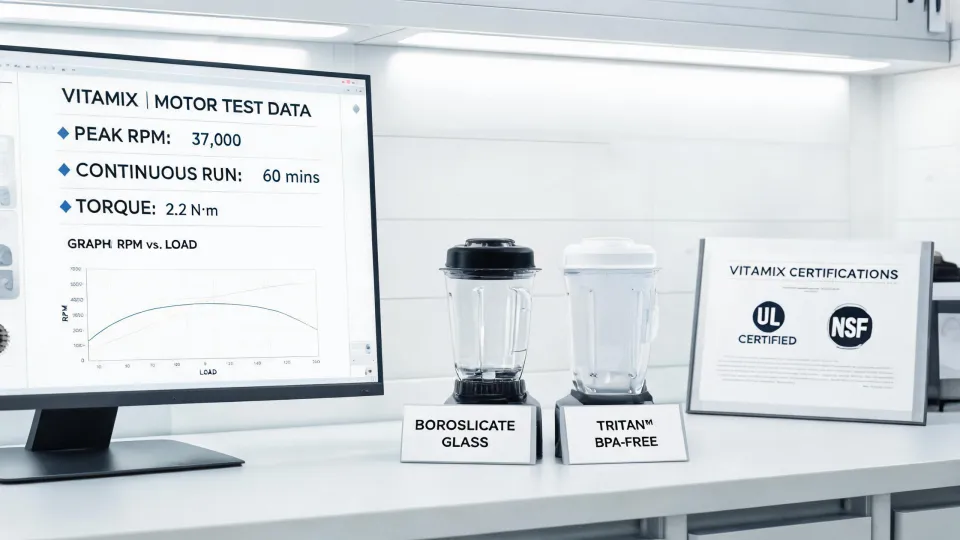
When I compared a popular 'prosumer' model and our standard Vitamix Vita-Prep 3 side by side—both rated at around 1,400 watts—I finally understood why the details matter so much. The prosumer unit had a plastic drive socket. The Vita-Prep had a stainless steel one. After 500 smoothies in our lab, the plastic socket had worn out. In a commercial kitchen, that's maybe two weeks.
Seeing those two units opened after our 500-cycle test made me realize something: power ratings are almost meaningless without the rest of the engineering. The motor is only as good as the coupling, the bearing, and the container.
Consistency Isn't a Feature—It's the Only Thing That Matters
In our Q1 2024 quality audit, we ran a blind test with our kitchen team: same recipe, same ingredients, same time, different blenders. One was a Vitamix commercial unit. The other was a top-rated home blender from a well-known brand. 90% of our team identified the Vitamix batch as 'more consistent'—smoother texture, less variation from batch to batch.
The cost difference at wholesale? About $150 per unit. On a 50-unit order for a new restaurant chain, that's $7,500 for measurably better output. And that doesn't factor in longer blade life, less repair cost, and fewer customer complaints. In my experience, the cheapest equipment always costs the most over a full year.
The 'One-Size-Fits-All' Lie
Some vendors claim their blenders can do everything—make almond milk, crush ice, grind spices, even heat soup. And you know what? They can. For about three months. Then something breaks.
I'd rather work with a specialist like Vitamix who knows their limits than a generalist who overpromises. Vitamix has the audacity to say 'this is a commercial blender for high-volume use, not a home appliance.' And that honesty earns my trust for everything else.
It also aligns with a fundamental truth: specialized tools beat multi-purpose ones, every time. Your dry-aging fridge won't also do pastry proofing. Your espresso machine won't brew drip coffee. So why should your $500 blender pretend to be a food processor? It can't. Not for long, not reliably.
The Argument I Keep Hearing—and Why It's Wrong
'But we're a small café. We don't blend that much.'
I've heard this from a dozen new café owners. In 2022, we supplied a fledgling smoothie bar with high-end home blenders to save money. Within four months, three units failed. The repair cost plus lost sales (two days of downtime each time) came to $2,200—more than the upgrade to commercial would have been.
Another common pushback: 'Our staff knows the home model already.' But retraining is cheap. Rebuying equipment isn't. And there's a safety issue too—home blenders often lack the overload protection needed for continuous use, which can lead to motor burnout and, in rare cases, fire. That's a risk I won't take.
Here's What I've Learned After Rejecting 50+ Substandard Blenders
Commercial is commercial. Home is home. The line exists for a reason. You wouldn't use a residential oven to serve 200 covers a night. Don't use a home blender to do 100 smoothies a shift.
For my clients, the recommendation is simple: if your daily volume is more than 20 blends, buy a certified commercial blender. The Vitamix Vita-Prep series is my benchmark. They're not the cheapest, but they're the most consistently reliable unit I've tested in over 4 years of doing this job.
I hit 'confirm' on our last bulk order—200 Vita-Prep units—and immediately thought, 'Did I get the volume discount right? Could we have negotiated harder?' But I didn't second-guess the specification. That decision was made years ago, after my first 500-cycle test. I haven't looked back.

Greta Lindholm
Greta Lindholm is a household refrigeration analyst covering French-door, side-by-side, top- and bottom-mount refrigerators, mini fridges, beverage coolers, chest freezers, and upright freezers. She applies IEC 62552 and IEC 60335-2-24 while comparing energy consumption, usable volume, pull-down time, compartment temperature stability, freezing capacity, noise, door-seal leakage, refrigerant charge, and ambient-temperature performance. Her guides help importers, distributors, private-label teams, and appliance engineers select platforms around climate class, storage mix, efficiency labels, cabinet dimensions, service access, shipping density, and warranty exposure.