Vitamix E320 Explorian Review: The $349 Blender That Cost Me $1,348
2026-08-11 · Greta Lindholm
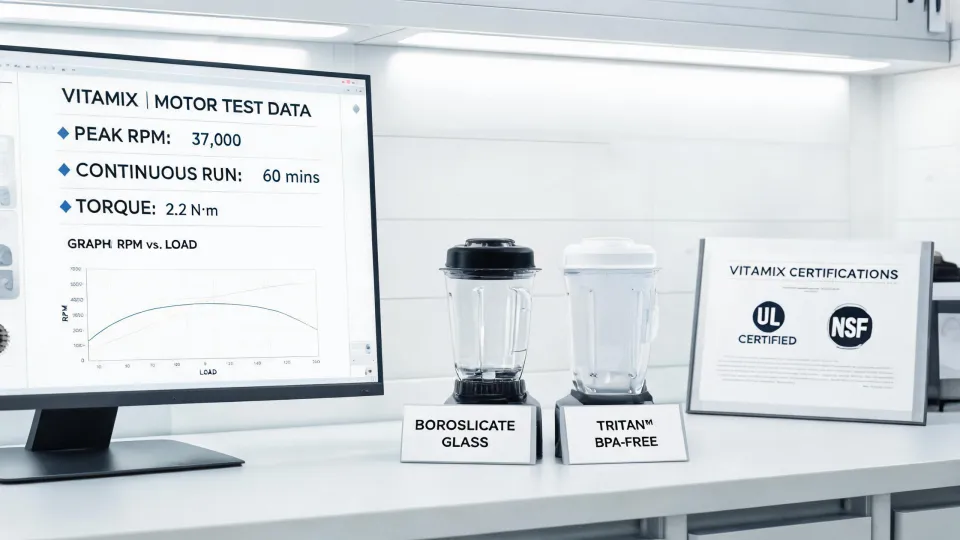
The most expensive Vitamix I've ever bought cost $349. That was the E320 Explorian, the "budget-friendly" model I picked up from a big-box retailer in March 2019 while outfitting a new juice bar. The comparison seemed obvious at the time: $349 for the E320 versus $849 for the Vitamix 036019, the commercial model everyone calls The Quiet One. A $500 gap. The cheaper blender had similar horsepower specs; I convinced myself the difference was mostly brand positioning.
Four months into service, the drive socket stripped during the morning rush. Warranty support was polite but clear: consumer Vitamix warranties don't cover commercial use. (I have the email.) The repair ran $150. Six weeks later, the motor bogged down and overheated on a heavy load of frozen fruit — again, during peak hours. I finally ordered the 036019 and paid $849 for the unit I should have bought first.
Total: $349 + $150 + $849 = $1,348. That's 59% more than the commercial blender's price tag, before counting the two weeks of downtime, the missed orders, and the staff who worked around a broken machine. The E320 isn't a bad blender. It's a great home blender. Using it commercially was my mistake, and it was expensive.
I'm an operations lead who's handled equipment procurement for juice bars, cafes, and full-service restaurants for six years. I've personally made (and documented) 14 purchasing mistakes that totaled roughly $8,400 in wasted budget. The #1 recurring error was comparing sticker prices instead of total cost of ownership (TCO). This article is the framework I use now.
Total cost of ownership: the five numbers a quote won't show
TCO isn't complicated. It means counting everything equipment will cost you while you own it. Five components cover most of the real picture:
- Purchase price. The invoice number. The least interesting number in the equation.
- Duty cycle. How long the motor can run before overheating. Consumer blenders are designed for intermittent use. Commercial units are built for continuous, high-volume operation.
- Maintenance and repair. Parts, labor, and how often they're needed. The E320's drive socket failure is a textbook example: consumer-grade parts under commercial load fail faster.
- Downtime cost. Revenue lost while the unit is dead. A juice bar without a working blender for a week loses far more than the price of a commercial unit.
- Compliance. NSF certification. Health departments require it in most commercial kitchens. If your blender isn't NSF-listed, an inspector will eventually make the point for you.
I'm not an accountant, so I won't pretend every dollar needs perfect tracking. But if you compare two blenders by looking only at component #1, you're not comparing. You're guessing.
Guessing is expensive.
E320 Explorian vs. 036019 The Quiet One: what actually differs
The E320 Explorian is a genuinely good blender. It has a 2.2 horsepower motor, a variable-speed dial, and a 64-ounce jar. On paper, it looks close to commercial models. That's exactly the trap.
The important differences aren't in the marketing specs:
- Drive socket and bearing tolerances. Consumer models are built for intermittent torque. Hours of daily blending wears the parts down far more quickly.
- Motor cooling. Commercial blenders have larger cooling systems because they're expected to run continuously. Consumer blenders need rest between blends — and "rest" doesn't exist during a lunch rush.
- Warranty language. Consumer warranties explicitly exclude commercial use. Not "may not cover" — explicitly exclude. And they ask about output volume when you file a claim.
The 036019 was engineered for the conditions that kill consumer blenders. That's what the higher price buys. For most commercial operations, the price difference pays for itself the first time you avoid replacing a failed unit during peak season.
If you're reading E320 reviews hoping it's the same machine for less money? That's exactly the assumption that cost me $499 in unnecessary spending. The specs look similar. The engineering isn't.
Why noise is a cost, not a comfort upgrade
Here's the counterintuitive part: the "quiet" in The Quiet One is an operational advantage, not a luxury feature.
At high volume, blender noise affects everything around it. Staff can't hear orders or each other. Customers in open kitchens wince at every frozen drink. At one juice bar I managed, two employees left within a month — they told me directly that the 8-hour noise level was a factor.
I'm not an acoustics engineer, so I won't quote decibel figures from memory. What I can tell you from operations: the difference is obvious on the first blend. After a full shift, it's significant.
Batch prep is where TCO shows up in real time
Running a commercial kitchen means answering a strange mix of questions. Staff ask, "how long is baked ziti good for in the fridge?" — the USDA guideline is 3 to 5 days for cooked pasta dishes refrigerated at or below 40°F. Then they ask whether the blender can handle a cold load straight from the cooler. Both deserve accurate answers.
I'm not a food safety specialist, so beyond basic guidelines I direct staff to the USDA and FDA sources. But batch prep doesn't require a specialist to understand: we make large batches of sauces, dressings, and smoothie bases at the start of the week. That means blending dense, cold ingredients repeatedly. A consumer blender bogs down on those loads — especially when the motor's already warm from the previous batch. The commercial unit doesn't.
That's a TCO issue because slow blending costs twice: extra labor on every batch, and frustrated customers during peak hours.
Quick boundary: people sometimes assume that because I buy blenders for a living, I can recommend any appliance. I've been asked about the Babyliss Pro extended barrel curling iron and carpet cleaners for cars. I don't have operational experience in those categories, so I don't offer opinions. This guide is about commercial blenders — specifically, the math that should come before any purchase.
The pre-purchase checklist I use now
After the E320 episode, I built a checklist that has caught 11 potential errors in the past 18 months. Here's the version I run before any blender purchase:
- Read the warranty's commercial-use policy. If it's excluded, this isn't a commercial blender. Walk away.
- Confirm NSF certification. If the model isn't NSF-listed, ask why. Your health inspector will.
- Estimate your daily duty cycle. How many blends per hour, how many hours per day? If the motor can't handle continuous operation, you're buying your next emergency.
- Calculate the downtime cost. What do you lose per day if this unit dies? Compare that against the price difference you're trying to save.
- Price the parts, not just the unit. A replacement jar, blade base, or tamper can turn a "bargain" into a bad deal.
- Listen to it run. Demo the unit if you can. If the noise bothers you in a showroom, it'll bother you more on day thirty.
When a consumer Vitamix is the right answer
I'm not saying every kitchen needs a commercial model. There are situations where a consumer Vitamix makes total sense:
- Home kitchens. The E320 is an excellent home blender. No question.
- Very low-volume commercial use. A coffee shop making a dozen smoothies a day might get away with a consumer model — but understand you're gambling the repair and replacement costs against the warranty exclusions.
- Menu trials. If you're testing a new product before committing to volume, a consumer blender is a cheaper way to validate demand. Just budget for the real unit when you scale up.
The issue isn't "consumer = bad, commercial = good." It's matching the tool to the duty cycle — and knowing what the choice will actually cost you.
Part of me still wishes I had that $499 back. And honestly, there's a part of me that wants to be mad at the warranty fine print. But the warranty did exactly what it said. The blender wasn't designed for what I asked of it. My decision-making process was the failure point, not the machine.
Run the TCO math before you buy. That's the difference between choosing a blender and guessing.

Greta Lindholm
Greta Lindholm is a household refrigeration analyst covering French-door, side-by-side, top- and bottom-mount refrigerators, mini fridges, beverage coolers, chest freezers, and upright freezers. She applies IEC 62552 and IEC 60335-2-24 while comparing energy consumption, usable volume, pull-down time, compartment temperature stability, freezing capacity, noise, door-seal leakage, refrigerant charge, and ambient-temperature performance. Her guides help importers, distributors, private-label teams, and appliance engineers select platforms around climate class, storage mix, efficiency labels, cabinet dimensions, service access, shipping density, and warranty exposure.