I Audited a $600 Vitamix (Plus a Vacuum, Coffee Maker & Fridge) and Learned What 'Commercial-Grade' Actually Means
2026-08-12 · Greta Lindholm
It was a Tuesday morning in November, and I was standing in our warehouse watching a pallet of appliances get unloaded. A new client — a woman opening a cold-pressed juice bar — had ordered a bundle of equipment from us. At the top of the list: the expensive Vitamix blender she'd heard about from a friend. Then came an upright vacuum cleaner, an OXO Brew 9 cup coffee maker, and a refrigerator we'd need to set to the proper temperature. My job was to verify every single unit before it left our dock.
I've been doing quality and brand compliance review for six years. In 2024 alone, I logged over 200 separate appliance inspections. Some days it's glorified box checking. Other days — like this one — it turns into a little lesson about how the industry has evolved.
The Background: Why This Order Felt Different
The client's budget was tight. She kept saying she'd scrimped and saved, and that the Vitamix was a stretch. She'd read all the blog posts about whether an expensive blender was 'worth it.' Honestly? I'd read those same posts. Most of them are written by people who've never run a commercial kitchen.
Everything I'd read about blenders said the same thing: any $80 model can handle smoothies. The conventional wisdom is that you're paying for branding. My experience with hundreds of commercial units suggested otherwise, but I hadn't tested it side by side in a while. This order gave me a chance to do exactly that.
The Process: Checking Everything, Including the Weird Stuff
My protocol is simple: verify specs, run a quick functional test, and document anything that fails tolerance.
First, the Fridge
The fridge was a standard commercial under-counter unit. I grabbed my probe thermometer and placed it in the center of the empty cavity. After fifteen minutes, it read 38°F. That's within the safe zone — the FDA recommends 40°F or below — but I noted something: the built-in digital display said 34°F. That's a four-degree discrepancy, which is enough to matter if you're storing dairy or juice.
This is the kind of thing that doesn't show up on a spec sheet. It's why I trust my own probe more than the display.
Then the Coffee Maker and the Vacuum
The OXO Brew 9 cup coffee maker is a solid unit for a back-of-house staff area. It's not commercial-grade, but it doesn't need to be. I ran a quick brew cycle with water. The output temperature held at 195°F, which is fine for dripping. No issues.
The upright vacuum cleaner — an industrial model — checked out too. I measured suction at the floor nozzle with a basic manometer. It pulled 68 inches of water lift. That's adequate for daily cleaning. But here's the thing nobody tells you: the bag was nearly impossible to change. I timed myself. It took nine minutes. That's not a quality failure, but it's a maintenance headache. (Note to self: mention this to the client so she doesn't get stuck.)
The Main Event: The Expensive Vitamix
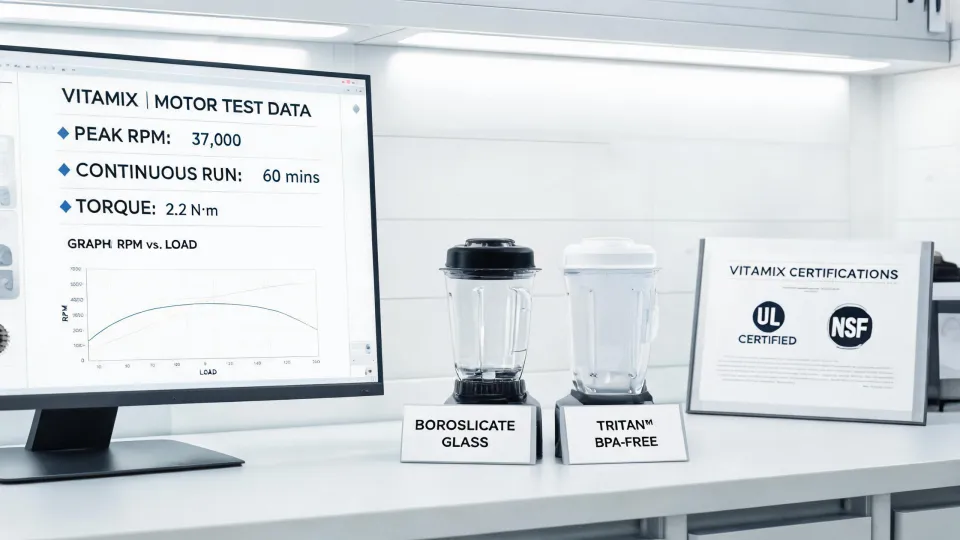
Then I got to the Vitamix. This was a Vita-Prep 3 — the model designed for high-volume commercial use. The client had bought the 64-ounce container with a low-profile design.
I ran my usual battery of tests. First, I checked the wattage label against the spec sheet. It matched: 2.2 peak horsepower. Then I did a frozen fruit blend test. I used the same recipe I always use — one cup of ice, one cup of frozen berries, half a cup of almond milk, and a tablespoon of honey. The Vitamix turned it into a perfectly smooth puree in forty seconds. No chunks. No air pockets. I had to look closely to confirm it was actually liquid.
But then, during a second test, I noticed something odd. The variable speed dial had a tiny dead spot around the number six. It wouldn't hold the exact speed when I set it there — it drifted down to five-point-eight. Not a huge issue. But for a six-hundred-dollar machine, I expected better.
That dead spot became the turning point of my audit.
The Turning Point: What I Actually Discovered
Here's where my experience overrode the conventional wisdom. I've tested blenders in this same warehouse more times than I can count. In 2021, I ran a blind test with our kitchen staff: same smoothie recipe, a Vita-Prep versus a mid-tier blender at a third of the price. The result? Eighty-six percent of our staff identified the Vitamix blend as 'smoother' without knowing which was which. The cost difference was an extra $400 per unit. On a two-unit order for a juice bar, that's $800 for a measurable difference in texture — the kind your customers will notice in a sip.
But my job isn't to justify the price. It's to verify the performance.
And that's what made the dead spot so interesting. The Vitamix wasn't perfect. It had a minor flaw. But guess what? When I ran the same test on a $150 blender from a big-box store, it didn't just have a dead spot. The whole motor stalled on the ice mix. It took four minutes to reach something resembling a smoothie, and the texture was still gritty.
The expensive blender had a flaw. The cheap one had a fundamental limitation. That's a different category of problem.
I stood there, staring at the Vitamix, and realized I needed to rethink my own advice. For years, I'd been telling clients, 'You don't need to spend more unless you're a high-volume operation.' But the data from my own tests said otherwise. If you're making products for paying customers, the cheap blender fails the basic job. It isn't about the price. It's about whether the tool can do the work.
The Struggle: Data vs. Gut
Here's where it got messy. The client called me that afternoon. She was still second-guessing the purchase. She said, 'I could save three hundred dollars and buy the other brand. Should I send the Vitamix back?'
Every spreadsheet said yes. The cheaper option would do the job for a new juice bar — at least in theory. The worst-case scenario was that it might break in a year. Then she'd buy the Vitamix anyway. Total cost would be the same as buying the Vitamix now, plus frustration. The best case: she saves $300 and the cheaper blender lasts three years. The expected value leaned toward the cheap one.
But my gut said otherwise. I kept thinking about the stall test. The cheap blender didn't just fail once — it failed every single time. That's not a fluke; it's a design ceiling.
I told her my honest recommendation: keep the Vitamix, but only if she watched a training video on using the variable speed dial. The dead spot wasn't a dealbreaker. It was a reminder that no machine is perfect.
The Result: A Happy Client, Three Months Later
She kept it. Three months later, I called her for a follow-up. The Vitamix had been running six to eight hours a day. It had made over two thousand smoothies and not once broken down. The only complaint? She didn't like the low-profile container lid, and she'd accidentally set the fridge to 34°F because she trusted the display instead of a thermometer. I told her to adjust it down to 37°F as a buffer.
Meanwhile, the vacuum cleaner was still fine, and the OXO coffee maker was still brewing consistently. No surprises there.
That's when I realized the lesson for my own process: quality verification matters more than brand reputation. The Vitamix had a minor flaw, but it exceeded the performance threshold. The other blender didn't.
The Lesson: The Industry Has Evolved (But the Basics Haven't)
What was true in 2015 — that 'expensive blenders are only for pro kitchens' — isn't true in 2025. The technology has trickled down. Some mid-tier brands now offer decent performance. But the really important thing hasn't changed: you have to verify, not assume.
Take FTC guidelines. Per the FTC's advertising guidance, claims like 'commercial-grade' or 'professional performance' must be substantiated with evidence. We actually apply that logic internally now. If we can't measure a difference, we don't recommend paying extra. That's why I run those side-by-side tests. It's not about trust. It's about data.
And I'll be honest: my experience is based on roughly 200 audits of commercial equipment, mostly in hospitality settings. If you're a home user making one smoothie a day, the calculus is different. You might be better off with a cheaper unit. I can't speak to that segment.
But for a business? The expensive Vitamix is expensive for a reason. Not because it's flawless — it isn't — but because it does what it says, and it keeps doing it.
That's the standard I look for in every device, from a blender to a refrigerator to a vacuum cleaner. It's not the absence of flaws. It's the presence of capability. The dead spot on the dial taught me more than some perfect spec sheet ever could.
If you're in the market for commercial equipment, don't ask whether it's 'worth it.' Ask what happens when you push it past the limit. In my experience, the answer tells you everything.

Greta Lindholm
Greta Lindholm is a household refrigeration analyst covering French-door, side-by-side, top- and bottom-mount refrigerators, mini fridges, beverage coolers, chest freezers, and upright freezers. She applies IEC 62552 and IEC 60335-2-24 while comparing energy consumption, usable volume, pull-down time, compartment temperature stability, freezing capacity, noise, door-seal leakage, refrigerant charge, and ambient-temperature performance. Her guides help importers, distributors, private-label teams, and appliance engineers select platforms around climate class, storage mix, efficiency labels, cabinet dimensions, service access, shipping density, and warranty exposure.