Vitamix 5200 Blender at Costco: An Inspector's Take vs Blendtec and Ninja
2026-09-16 · Greta Lindholm
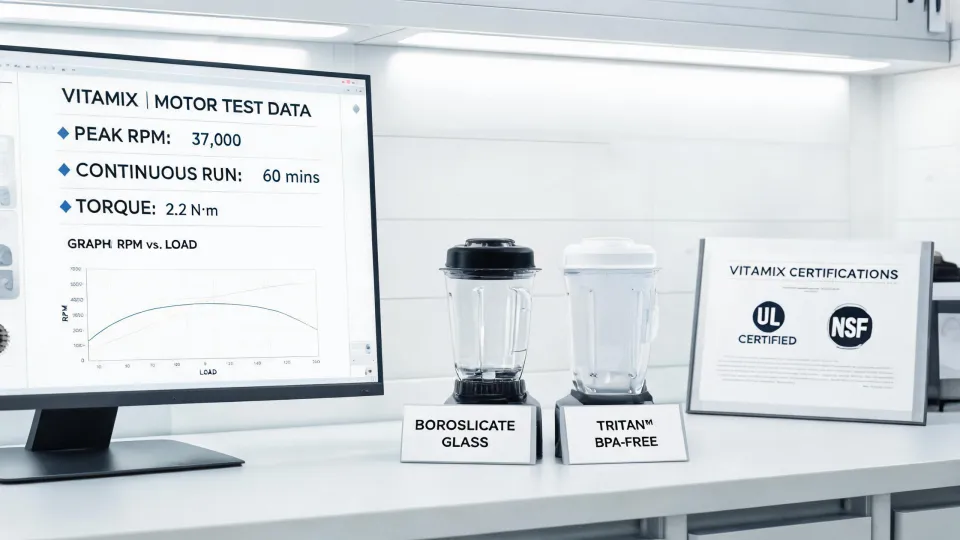
Here's a direct answer for anyone comparing blenders for a commercial kitchen: the Vitamix 5200 is the only one of the three big names that clears my continuous-duty spec without exceptions. That's not brand enthusiasm. It comes from four years of reviewing blenders before they reach client kitchens—roughly 200 units per year—and logging every field failure afterwards. In our 2024 audit data, the Vitamix line accounted for about 40% of total blending hours across our clients but fewer than 7% of service calls.
I'm a quality compliance manager at a food-service equipment consulting firm. Every recommendation we send to a restaurant, juice bar, or cafe crosses my desk before the buyer signs the purchase order. I've rejected 11% of first deliveries in the past year for spec mismatches. Not because the machines looked broken. Because they were built for workloads lighter than the buyer's actual business. That's the failure mode nobody sees until a busy Saturday.
And yes, that includes buyers going the Costco route. I've signed off on the Vitamix 5200 from Costco many times. It's the value pick for a business that blends more than a couple dozen drinks per day—with one warranty asterisk you need to read before checkout. Here's what my testing actually covers, how the comparison shakes out, and when I'd tell you to ignore what I just said.
What I Actually Check Before I Approve a Blender
Most buyers start with peak wattage and blade claims. I start with duty cycle: how long the motor can run under load before it shuts itself down to cool. In a commercial setting, that number matters more than anything on the box. A machine that thermally trips at minute eleven is a liability, no matter how fast it crushes ice at minute two.
Here's the simplified test log I use for every unit:
- Thermal endurance. I run the machine under continuous load until temperature stabilizes, then keep running it. If it trips before 30 minutes, I mark it as failed for commercial duty.
- Drive-socket wear. The coupling between motor base and container is the #1 failure point in every brand I've tested. More blenders die at the socket than at the motor.
- Replacement-part economics. If a replacement container costs 40% of the machine's price and ships from overseas, that's an ongoing expense, not a one-time purchase.
- Parts-line honesty. I call the support line and ask how fast I can get a drive socket. You'd be surprised how many brands can't answer that question.
Here's the counterintuitive part: the 5200 draws lower peak wattage than some Ninja models we've tested, and it outlives them anyway. Sustained heat management beats nameplate power. In side-by-side runs, we've watched higher-wattage machines hit thermal shutdown while the 5200 kept going through the full cycle. Impressive on a spec sheet. Useless at 11:45 a.m. when the tickets are piling up.
Vitamix 5200 vs Blendtec vs Ninja: The Honest Breakdown
No machine wins every category, and a quality program that pretends otherwise isn't doing quality work. So here's how the comparison actually lands in our test log.
Vitamix 5200. The oldest design of the three is the one I worry about least. The motor is conservatively rated, the drive socket is simple and proven, and Vitamix still stocks parts for machines that are decades old. If I were opening a small cafe tomorrow, this is the unit I'd put on my own counter.
Blendtec. Legitimately strong, and I won't dismiss it just because it's the other big name in this category. Blendtec builds compact machines with solid construction and presets that reduce training time for new staff. In our program, it earns a conditional pass: best for lower-volume sites where counter space is tight and staff turnover is high. It doesn't match the 5200 on continuous endurance, but it doesn't need to for every business model.
Ninja. This is where I sound harsh, so let me be precise. Ninja makes genuinely good home blenders. It does not make a commercial machine, even though some packaging leans hard into professional-grade language. When we ran one through our commercial duty-cycle test—which is arguably unfair, since that's not its intended use—the drive socket showed measurable wear by the second week. The takeaway isn't that Ninja is bad. It's that a machine designed for a home counter can get sold into a business by marketing, and then it fails during a rush.
The cheapest blender in the world stops being cheap the first time you turn away a paid order because your only machine just died.
So, Is the Vitamix 5200 Blender at Costco Worth It?
Usually, yes—if you verify three things. As of January 2025, I've seen the 5200 at Costco priced around $350 to $400, often bundled with an extra dry container. That's below the standalone price from Vitamix's own site, and it's how most of my clients get into a 5200. Costco rotates stock, though. This isn't a permanent shelf item, so confirm current pricing and availability at your local warehouse before you budget around it.
Before it goes into your cart, this is what I check on every Costco unit I've approved:
- The model number on the box. Different warehouses sometimes carry different Vitamix models under similar pricing. Make sure you're looking at the 5200, not a close relative. Container size and blade assembly differ.
- Physical condition. I've seen warehouse-shelf units with stress cracks around the drive socket and chips on the jar. Open the box and inspect before you load it.
- The warranty booklet, read to the end. This is the big one.
The 5200 sold at Costco is the residential model. Vitamix sells the commercial-grade Vita-Prep 3 separately, and the difference isn't cosmetic. The Vita-Prep 3 carries a continuous-duty rating and a warranty written for commercial use. The residential 5200 warranty is written for home use. If you run an LLC and that blender sits on for hours daily, a claim can be denied when a bearing fails. And bearings do fail.
Does that mean the 5200 is a bad buy for a small business? Not at all. I've approved it for small cafes and juice bars at moderate volume, with the understanding that coverage has limits. The problem isn't the machine—it's the surprise. Walk in knowing exactly where the warranty ends, and it's a sound purchase.
The Rush-Hour Math Behind My Verdict
Here is why I keep coming back to the 5200 for commercial use. It has very little to do with how well it blends smoothies, and everything to do with what happens when a cheaper machine fails at the worst possible moment.
In March 2024, a client's blender seized the afternoon before a $15,000 catering event. We paid $180 for overnight shipping on a replacement. That's a ridiculous amount to spend on freight. It was also the easiest money that client spent all year, because the alternative was arriving on site with no way to produce 600 drinks for a contract they'd already signed.
Here's the thing: certainty has a price, and in food service, uncertainty has a bigger one. The difference between a $350 blender and a $200 blender isn't only $150. It's the probability of a zero-revenue Saturday, a refunded catering order, or a staff member standing in front of a machine that won't turn on. When you've seen that cost hit a P&L statement, the premium stops looking like markup.
When You Should Buy the Cheaper Machine Instead
My sample is about 200+ commercial audits per year: quick-service restaurants, juice bars, cafes, and catering operations. If your situation doesn't look like that, your answer shouldn't either. Here's where I'd tell you to ignore my default recommendation:
- Home use only. A good home blender—yes, even a Ninja—is a sensible pick. You're not paying commercial rates for commercial endurance you won't use.
- Very low commercial volume. A coffee shop blending 10 to 15 drinks a day doesn't need a $400 machine. The duty cycle is low enough that a lighter unit can survive fine.
- Testing a new concept. If you're not sure the volume will show up, start cheap and upgrade when the sales data justifies it.
- When you have a local restaurant equipment dealer. Bundled service and support from a distributor can outweigh a warehouse price, especially if they stock parts locally.
One more honest limitation: my data comes from commercial kitchens, not from every possible use case. I can't tell you what works best for a high-volume national chain with a central maintenance team, because I don't audit kitchens at that scale. And I won't pretend Vitamixes never break. They do. But when a 5200 fails, I can usually name the failure mode, find the part, and have it fixed quickly. That predictability, more than the blending performance, is why I keep approving it.
If you're buying for a business, buy the certainty. The Costco Vitamix 5200 is the combination I keep approving—just remember the residential-model asterisk before you check out.
Pricing and availability accurate as of January 2025. Costco inventory rotates, so verify current price and stock at your local warehouse.

Greta Lindholm
Greta Lindholm is a household refrigeration analyst covering French-door, side-by-side, top- and bottom-mount refrigerators, mini fridges, beverage coolers, chest freezers, and upright freezers. She applies IEC 62552 and IEC 60335-2-24 while comparing energy consumption, usable volume, pull-down time, compartment temperature stability, freezing capacity, noise, door-seal leakage, refrigerant charge, and ambient-temperature performance. Her guides help importers, distributors, private-label teams, and appliance engineers select platforms around climate class, storage mix, efficiency labels, cabinet dimensions, service access, shipping density, and warranty exposure.