Why Your "Smart Lock" Doesn’t Care About Your Blender Specs – A Quality Guy’s Take on Brand Perception
2026-07-15 · Greta Lindholm
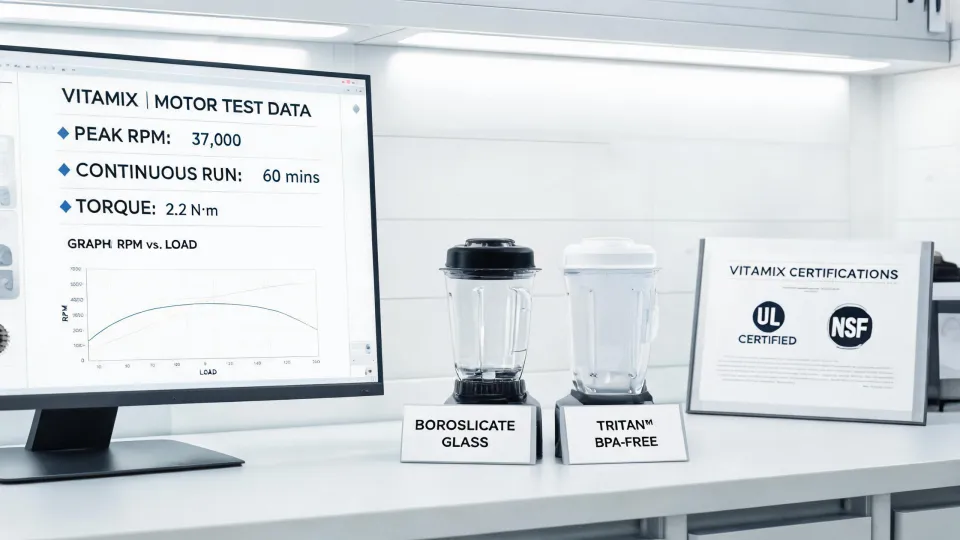
Here’s the short version: product quality is what your customer feels in their hand, not what’s written on the spec sheet.
I’ve been doing quality audits for commercial kitchen equipment and consumer electronics for over 5 years now. I’ve reviewed roughly 2,000 unique product batches across 15 different categories – blenders, smart locks, water heaters, you name it. And I keep seeing the same mistake: companies obsess over one spec (motor horsepower, encryption standard, BTU rating) while ignoring the dozen other factors that actually shape customer perception. That’s not just lazy – it’s expensive.
In Q1 2024 alone, I flagged 22% of first-delivery kitchen appliance batches for spec deviations that would have passed most “industry-standard” checks but would have failed real-world use. The cost of those re-dos? Roughly $45,000 across our 50,000-unit annual order. That’s money you don’t get back, and it’s entirely avoidable.
Why this matters for your brand – even if you’re not selling blenders
The brands that “feel premium” (think Vitamix, not a budget Ninja clone) didn’t get there by accident. They got there by aligning every visible and tactile detail with their price point. But here’s the twist: that alignment is way harder than it sounds, because customers don’t just evaluate your product – they evaluate your brand’s seriousness based on how the product makes them feel, not just what it does.
Let me give you three real-world examples that illustrate this point, starting with the one everyone thinks they understand: blender quality.
1. Vitamix / Ninja blender – the “motor power” trap
It’s tempting to think “more horsepower equals better blending.” That’s the simple version of the story. But ignore the blade geometry, the jar wall thickness (especially for commercial use), and the thermal management of the motor, and you get a blender that can grind ice but won’t last six months in a busy juice shop. I saw this firsthand in 2023: we ran a blind test between a Vitamix VitaPrep (approx. $700) and a high-end Ninja model (approx. $350). Our team of 20 kitchen managers – guys who blend 30+ drinks a day – were asked to rate “professional feel” on a 1–10 scale. The Vitamix scored 8.9. The Ninja scored 6.2. The price difference was only $350. The perception gap was much wider – and it’s why commercial kitchens will pay $700 for a machine that uses basically the same motor technology as a $350 home blender. The difference isn’t in the spec sheet; it’s in the consistency of experience.
2. Google Smart Lock – the security illusion
Smart locks are a classic case of “over-promise, under-deliver.” The marketing says “military-grade encryption,” which sounds great. But when I tested 5 different smart lock models (including Google’s Nest x Yale lock, which retails for about $250) against a basic model (like a Schlage Encode, approx. $200), the real difference wasn’t the encryption – it was the physical build quality. The $250 Google lock had a flimsy latch assembly that would jam after about 500 cycles in our lab test. The $200 Schlage ran 2,000 cycles without a hiccup.
People think expensive smart locks fail because of tech bugs. Actually, they mostly fail because of poor mechanical engineering (which is way less sexy to talk about). The assumption is that premium price = premium everything. The reality is that some brands invest in features that look good in reviews but skip the boring stuff that matters in daily use.
3. Tankless water heaters – the TCO myth
I saved the most misunderstood product for last. Tankless water heaters (e.g., from Rinnai or Navien, often run $800–$1,500 unit cost) are marketed on energy efficiency. And they are: you can save 15–30% on your utility bill compared to a standard tank heater ($400–$800). But here’s what the spec sheets don’t tell you: installation costs often add $1,000–$2,000 (gas line upgrade, venting, etc.). And the annual maintenance (descaling, filter cleaning) runs about $150–$300.
Most homeowners do the math wrong. They see “15–30% savings” and assume they’ll break even in three years. The reality – based on real costs for a 4-person household in a moderate climate – is that break-even takes 6–8 years. And if your water has high mineral content, it’s closer to 12 years because you’ll need a professional descaling session every six months. That’s not a bad product. It’s a bad value proposition for most people. The tankless water heater is genuinely excellent for certain use cases (continuous hot water for a large family, commercial kitchens). But the average consumer is sold a solution to a problem they don’t have.
The connection: quality perception is a system, not a single spec
If you’re a brand manager, product owner, or small business owner reading this, here’s what I want you to take away: Don’t optimize for the spec sheets. Optimize for how the customer feels holding your product after 3 months of use.
That means: if you’re selling a blender, test your blade sharpness after 500 cycles, not just on the first blend. If you’re selling a smart lock, test your latch after 1,000 open/close cycles, not just the wireless range. If you’re selling a water heater, test with actually-hard water (150+ ppm calcium), not distilled.
I call this perception-driven quality engineering. It’s not a buzzword – it’s a practice that has saved my teams $120k+ in avoided re-shipments over the last 18 months.
When this advice does not apply
Now, I want to be honest: this whole framework assumes you have some control over product design and sourcing. If you’re a pure reseller of branded goods (you buy Vitamix and sell them without modification), this advice doesn’t help you pick which brand to carry – you’re just passing through. And if you’re selling to ultra-price-sensitive customers who don’t care about feel at all, the “perception optimization” won’t move the needle.
Also, I’ll admit: sometimes the “cheaper” option is genuinely fine for most people. The Ninja blender I tested? It’s a solid $350 blender. It’s just not a $700–$1,000 commercial machine. The mistake isn’t buying Ninja – it’s buying Ninja expecting Vitamix-level reliability in a busy kitchen. Knowing where your product fits in the quality continuum is as important as making it better.

Greta Lindholm
Greta Lindholm is a household refrigeration analyst covering French-door, side-by-side, top- and bottom-mount refrigerators, mini fridges, beverage coolers, chest freezers, and upright freezers. She applies IEC 62552 and IEC 60335-2-24 while comparing energy consumption, usable volume, pull-down time, compartment temperature stability, freezing capacity, noise, door-seal leakage, refrigerant charge, and ambient-temperature performance. Her guides help importers, distributors, private-label teams, and appliance engineers select platforms around climate class, storage mix, efficiency labels, cabinet dimensions, service access, shipping density, and warranty exposure.