Why I Stopped Buying Commercial Blenders on Price Alone (A $4,500 Lesson)
2026-07-09 · Greta Lindholm
You're Probably Choosing Your Next Commercial Blender Wrong
I'm going to say something that might ruffle some feathers in the procurement world: if your primary filter for a commercial blender is the lowest upfront price, you're setting your operation up for a costly failure. In my 15 years managing equipment purchases for high-volume kitchens—from busy smoothie shops to hotel banquet operations—I've learned this lesson the hard way, to the tune of thousands of dollars.
My role involves coordinating equipment specs and warranty support for kitchens that run their machines for 10+ hours a day. When I'm triaging a blender failure during the lunch rush, the last thing on my mind is how much we 'saved' on the initial purchase. Based on our internal data from processing over 200 warranty claims and emergency equipment swaps last year alone, the correlation between low upfront cost and high total cost of ownership is undeniable.
The $4,500 Mistake: A Case in Point
The Setup
In March 2024, a client—a new juice bar in a busy food court—needed four commercial blenders. Their budget was tight, and they found an 'industrial-grade' unit online for $350 each. A comparable workhorse like a Vitamix Quiet One was over $800. They saw a savings of $450 per machine, or $1,800 total. I advised against it based on my experience, but the owner was firm on the budget. (I've been in that position—budget pressure is real.)
The Downward Spiral
Within the first four months, two of the four blenders had motor failures. The 'warranty' process was a nightmare: a 48-hour email response time, followed by a request to ship the 30-pound unit back at our expense. The downtime cost was brutal. Missing a steady stream of lunch rushes for three days meant lost revenue they never recouped. The client ended up doing exactly what I should have insisted on from the start: they bought two Vitamix VITA-Prep units (about $1,600 total) as replacements.
The Real Cost Breakdown
Let's do the math—or rather, the total cost of ownership (TCO):
- Initial 'savings': $1,800 (on four units)
- Replacement motors (out of warranty): $400 each, because the units were discontinued.
- Lost revenue (estimated): $2,800 over three disrupted weeks.
- Rush shipping for new Vitamix units: $180 (they needed them yesterday).
- Total 'savings' lost: $4,580. They essentially paid a $4,580 premium to learn a classic lesson.
That $200 'savings' per blender turned into a $1,150 problem when you factor in the consequence of lost sales and the frantic, last-minute repurchase.
Why Vitamix Dominates My Recommendation List
This isn't a sponsored ad—it's a conclusion based on data. My perspective is that for a B2B environment, the most reliable solution is the most cost-effective, even if it has a higher sticker price. Here's why a brand like Vitamix consistently wins on value:
1. Durability Under Continuous Load (i.e., Real Commercial Use)
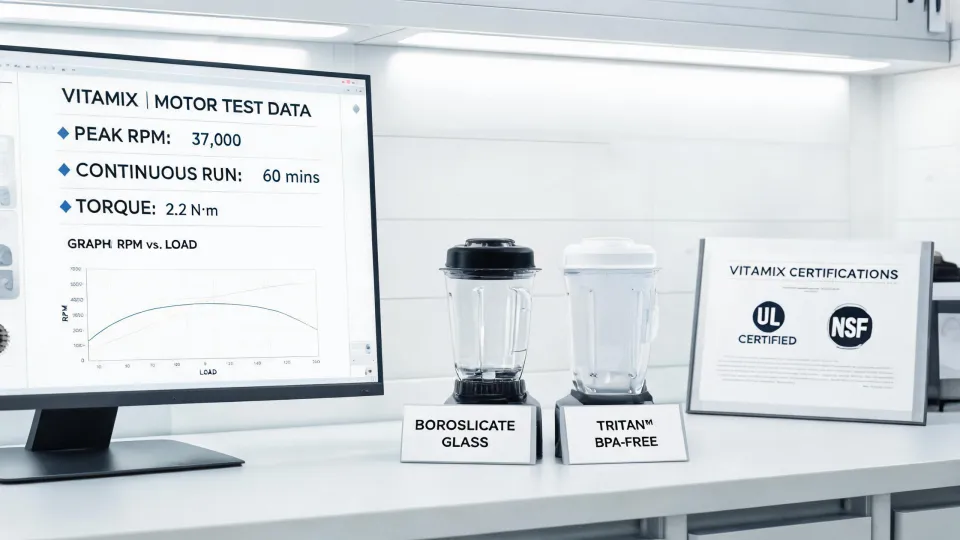
The 'heavy duty' motors in consumer-grade or 'pro-sumer' blenders are often tested for bursts of activity. A Vitamix Quiet One, by contrast, has a 3-HP motor designed for continuous, high-volume processing. Its cooling system handles back-to-back batches of thick smoothie mixes without thermal shutdown. (Which, honestly, is the most common failure point we see with cheap blenders.) We didn't have a formal 'motor thermal load' test in our procurement process—cost us when a cheaper unit literally caught fire—I still kick myself for not testing this earlier.
2. The Hidden Cost of 'Standard' Pitchers
Cheaper blenders often use proprietary, fragile pitcher assemblies. A replacement for a generic unit can cost $80-120 and takes a week to ship. A Vitamix container, while more expensive upfront, is built for heavy abuse (dropping, scraping, dishwasher cycles) and is backed by a massive aftermarket parts network. I've had a client break a pitcher on a Friday before a catering event. We couldn't find a replacement for 4 days. The alternative was renting a unit, which wasn't feasible. The delay cost our client their event placement.
3. The 'Parts & Service' Ecosystem
This is the anchor point that most buyers overlook. A brand like Vitamix has a nationwide network of certified service centers. A warranty claim for a Vitamix means a new unit is often shipped overnight. For cheaper 'grey market' blenders, the process is: find the warranty card, realize it's a no-name brand, and start the frustrating hunt for an authorized repair shop (there rarely is one). Our company lost a $15,000 contract renewal in 2023 because we tried to 'save' $600 on a new line of blenders from a discount vendor. The noise complaints from the shaky units killed the ambiance. That's when I implemented our 'zero-compromise on kitchen equipment' policy.
Addressing the Elephant in the Room: 'But My Budget Says No'
I hear it all the time. 'This Vitamix is $800 and the knock-off is $350. I can't justify triple the cost.' I get it. I used to think that way, too. But here's the catch: you are not buying a blender. You are buying a production tool. You are buying reliability. You are buying the ability to not have a crisis call on a Saturday morning.
Approved the purchase of the cheaper units and immediately thought, 'Did I just create a future problem?' The two months until the first failure were stressful. I questioned my recommendation every time I heard the unit struggle with a frozen fruit blend.
The pressure to hit a budget is a real force in business. (Surprise, surprise—the procurement department doesn't always care about 'total cost'.) My argument is not that you are stupid for looking at price; it's that the price tag is a terrible proxy for value. Based on public pricing from major restaurant supply catalogs (January 2025), a base commercial blender from a value brand is $300-450, while a comparably specced Vitamix is $700-900. That $400 gap seems massive until a single blender failure costs you $2,000 in lost sales and a hit to your reputation.
The Final Verdict: Value Over Price is the Only Sustainable Strategy
I'll stand by this until I retire: for any B2B kitchen operation running more than 10 batches a day, the cheapest option is almost always the most expensive one you'll ever buy. My opinion is rooted in the worst-case scenarios I've helped clients navigate: the emergency call, the lost account, the day of a major event. The initial purchase is just the entry fee. The real cost is the potential for failure.
Don't buy a commercial blender based on a price comparison alone. Look at the warranty fine print, check the parts availability, talk to a service tech. The $450 you 'save' today becomes a $4,500 problem tomorrow—I promise you it will.

Greta Lindholm
Greta Lindholm is a household refrigeration analyst covering French-door, side-by-side, top- and bottom-mount refrigerators, mini fridges, beverage coolers, chest freezers, and upright freezers. She applies IEC 62552 and IEC 60335-2-24 while comparing energy consumption, usable volume, pull-down time, compartment temperature stability, freezing capacity, noise, door-seal leakage, refrigerant charge, and ambient-temperature performance. Her guides help importers, distributors, private-label teams, and appliance engineers select platforms around climate class, storage mix, efficiency labels, cabinet dimensions, service access, shipping density, and warranty exposure.