When All Our Blenders Died, I Rebuilt the Prep Kitchen Around a Vitamix
2026-08-24 · Greta Lindholm
The Day the Blender Started Smoking
When I took over purchasing for our office building in early 2023, I was the administrator for a 120-person company managing facility and kitchen equipment orders—roughly $60,000 a year across eight vendors. I report to both operations and finance, which in practice means everyone has an opinion about what I buy.
The first equipment call I got was ominous: the blender in the prep kitchen had started smoking mid-shift, and the backup unit had a cracked pitcher from someone blending frozen fruit without enough liquid. Our prep kitchen serves about 80 to 100 employees per day, smoothies in the morning, soups at lunch. We'd been running two consumer-grade blenders purchased in 2021. Both failed within 18 months, and my usual kitchen supply vendor was no help—they carried paper products and glassware, not actual commercial equipment.
So I did what any facilities buyer with no deep gear expertise does: I went browsing.
Does Vitamix Make a Juicer? (Short Answer: No)
The searches started broad: "commercial blender for small cafe," "heavy duty blender for daily use." Vitamix kept showing up. Once I landed on the brand, the spec sheets made sense—their commercial units are designed for continuous use in kitchens that produce hours of output per day, not five-minute tasks.
But I had a gap in my knowledge. A staff member asked whether we'd ever offer fresh orange juice at breakfast, and I didn't know if Vitamix made a juicer too. So I typed "does Vitamix make a juicer" and got the answer fast: no. Vitamix doesn't manufacture a dedicated citrus press or masticating juicer. Their blenders handle whole fruit by pulverizing everything together, which keeps the fiber rather than pressing it out. Depending on your menu, that's either a plus or a minus.
For us it was a plus. We don't do juice shots or pulp-free drinks. We do smoothies and cream soups, where the fiber helps texture and nutrition. That question got answered in one search. The next one was more complicated.
The Vitamix Stainless Steel Blender Container Debate
The commercial model I settled on—the one our budget could survive—was the Vita-Prep 3. It's the model that shows up in fast-casual smoothie shops and hotel bars, and after a year of daily use I understand why. The motor never once strained on frozen fruit, and the variable speed dial is straightforward enough that part-time staff learned it in one shift.
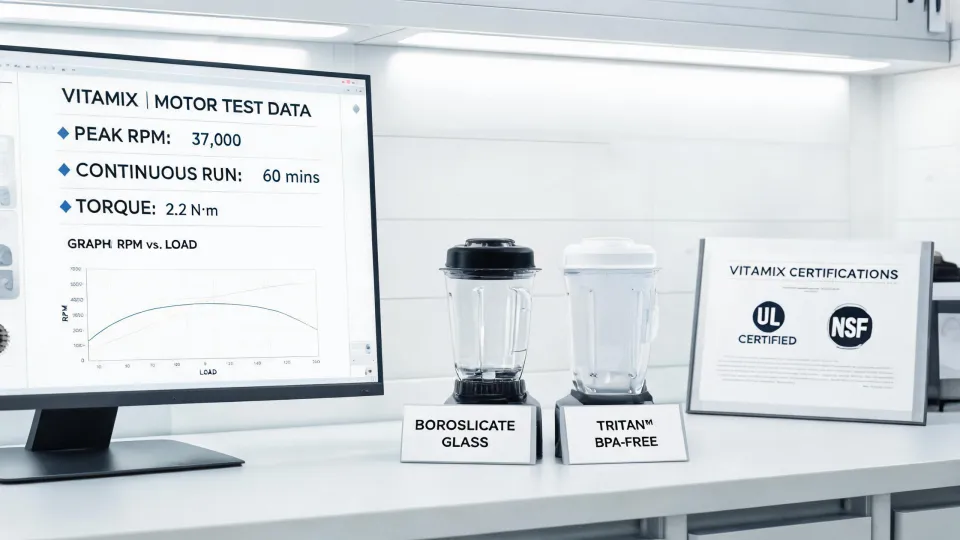
Choosing the container took more thought. The phrase that kept coming up in my research was "vitamix stainless steel blender container." It's available on some commercial units, and it costs meaningfully more than the standard Tritan plastic container. My finance director, who reads every line of the budget, asked, "Is that necessary, or just shiny?"
To be fair, that's a reasonable question. I gave him three answers:
- Plastic containers can cloud and scratch with heavy daily use, especially when blending frozen ingredients. Scratched surfaces create spots for bacteria to hide in—something a food-service inspector is actually trained to check.
- We blend hot soup bases in the same container. Both the Tritan and stainless options are NSF/ANSI 8–listed on the commercial models, to be clear. My discomfort wasn't about compliance; it was about how scratched surfaces behave over time in a shared kitchen.
- Durability. The stainless container is a welded piece of equipment, not a molded component. Heavier, better able to survive being picked up and put down a hundred times a week.
Granted, the stainless steel container has downsides you don't realize until you own one. You can't see through it, so "did I forget the banana?" becomes a daily question during morning rush. And it's heavy enough that smaller staff members will complain at some point. If I were purely optimizing for ergonomics and visibility, I might have chosen plastic. For our circumstances, the metal was worth it.
We ordered it in late March 2023. It arrived in nine days, faster than the quoted twelve. (That's rare enough in this industry that I wrote it in my notes.)
Meanwhile, the Rest of the Kitchen Was Falling Apart
Once I'd placed the blender order, the kitchen decided to reveal its remaining sins.
The Countertop Kitchen Hood
Our prep station has a countertop kitchen hood above the induction burners and soup pot. It's a compact vent system, not a full commercial exhaust, but it's vital—without it, the smoke detector in that room goes off every time the soup base reaches a boil.
I'd noticed a grease film on the filter for months. By the time I called a maintenance company, the fan was vibrating badly and dripping oil onto the flat top below. The first company I contacted (a big commercial kitchen outfit) wouldn't even put us on the schedule—"too small a system." The second one had a three-week wait, a $650 minimum call, and then parts on top.
This is where the small-client frustration kicked in. I get why profitable companies prioritize big contracts. But businesses with modest orders still matter, and finding vendors willing to work at that scale is half the battle in this job. The ones who show up for the small stuff become the ones you call when the order grows bigger months later. I honestly don't know why more service companies don't see it that way.
The company that finally came out did a proper job—cleaned the blower and replaced the charcoal filter—and then dropped the bad news: the duct didn't meet NFPA 96 clearances for grease ducting. We had roughly six weeks before the fire inspector's annual visit. That sent me scrambling for a sheet-metal contractor who could modify the duct. He charged us $880, and the inspection passed without a single citation.
The Vinyl Floor Scrubber Machine
Same week, the vinyl floor scrubber machine in the cafe died. It's a walk-behind unit we use on the sealed concrete and vinyl tile in the eating area. One of the brushes seized, and the repair quote from the dealer was $730—for a machine that cost $1,010 new. I approved the repair because budget approval for a new machine would have taken a month, but I knew it was dead money.
Three weeks later, the motor went. Lesson learned: if a repair costs more than half the replacement price and the machine is more than two years old, replacing it is usually the smarter call. I ended up buying a commercial-grade unit at $2,300 that does a noticeably better job on the cafe floor, which no longer feels sticky by 11 AM. The mop bucket went back to spot spills only.
What I didn't realize about floor scrubbers is how much capacity varies between models. The cheap units are built for a small office kitchenette, not a self-serve cafe with daily food traffic. Same pattern as blenders, honestly.
How to Get Mold Out of Front Load Washer (Because There Was No Escape)
And because things come in threes, the staff laundry room joined the chaos. The front load washer—used for cafe aprons and cleaning cloths—developed that unmistakable musty smell. I looked up "how to get mold out of front load washer" and followed the standard playbook:
- Run a hot cycle with two cups of white vinegar, no clothes, no detergent.
- Then run a second hot cycle with half a cup of bleach.
- Then wipe down the door gasket with a dilute bleach solution—that's where the black spots hide.
That covered about 80% of the smell. The remaining odor came from the drain pump filter, which had a dried-up sock wrapped around a wad of lint. Removing it felt like a surgical extraction, and suddenly the machine smelled like a machine again.
The real fix was behavioral: we printed a label reading "leave the door open when the washer is not in use" and stuck it next to the machine. Eight months later, zero musty smells. If you see mold in a front loader, it's usually not the washing process itself. It's the door being sealed while the interior stays wet.
What the Whole Project Cost and What I'd Tell Another Buyer
The full saga—blender, stainless container, hood repair, duct modification, floor scrubber replacement, washer cleaning—came to about $5,200 in purchases and repair fees, plus a meaningful amount of my sanity. The blender was the largest single piece and the one I'd defend most strongly.
"Approved. But I want a report next quarter on whether the equipment failure rate actually drops." — my operations director, signing off on the purchase
If you're buying for a small commercial or serious home operation, here's my advice:
- Search the question, even the "obvious" one. Asking "does Vitamix make a juicer?" taught me more about their product philosophy than ten product pages did.
- Buy for daily use, not for the week you happen to be planning. Commercial-grade gear is built for duty cycles. Consumer gear is built for occasional tasks. The price hurt at first, but the replacement cycle we'd been on would have cost more in three years.
- Budget for the ecosystem, not just the machine. The stainless steel container was a separate line item. The hood required contractors. The scrubber required a different vendor. Big purchases carry support costs—plan for them.
- Don't let the small size of your operation make you accept poor service. Ask directly whether a vendor services small accounts. Many say yes; some show you what they truly think. Those latter ones won't see our business again, but I don't need to tell them why.
I can only speak to our situation—a mid-size office cafe with a small staff and predictable hours. If you're running a high-volume restaurant, the calculus is different. You might need multiple blenders, a different container material policy, and a bigger exhaust system entirely. But I'd guess the key principle scales: buy the right tool for sustained use, find vendors who respect your order size, and fix the washer before the smell finds its way into the aprons.

Greta Lindholm
Greta Lindholm is a household refrigeration analyst covering French-door, side-by-side, top- and bottom-mount refrigerators, mini fridges, beverage coolers, chest freezers, and upright freezers. She applies IEC 62552 and IEC 60335-2-24 while comparing energy consumption, usable volume, pull-down time, compartment temperature stability, freezing capacity, noise, door-seal leakage, refrigerant charge, and ambient-temperature performance. Her guides help importers, distributors, private-label teams, and appliance engineers select platforms around climate class, storage mix, efficiency labels, cabinet dimensions, service access, shipping density, and warranty exposure.