Vitamix Power Blender vs. Budget Blenders: What a Quality Inspector Actually Checks
2026-08-03 · Greta Lindholm
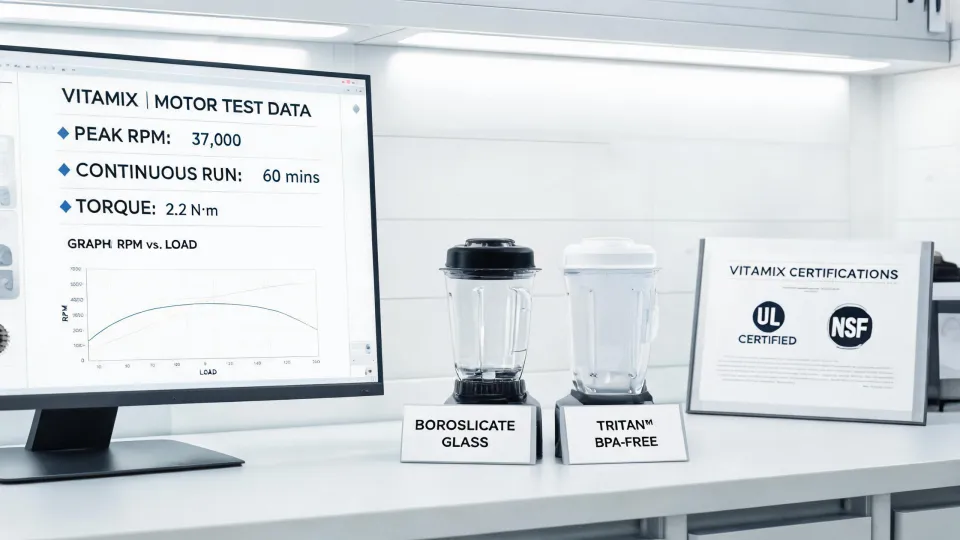
I'm a quality and brand compliance manager at a small appliance distributor. I review every appliance before it reaches customers—roughly 200 items each year. I've rejected 11% of first deliveries in 2024 because specs didn't match what the vendor promised. Over four years of doing this, the pattern is consistent: buyers fall for the flashy number and miss the spec that keeps the machine alive.
That's why when someone asks me about a Vitamix power blender, I don't start with design. I start with the grind.
Vitamix Power Blender vs. Budget 'Power' Blender
Let's make the comparison clean. A is a real Vitamix—for heavy commercial use, that's the Vita-Prep line; for a premium home/office setup, it's the Ascent X5. B is the generic much-cheaper machine that says 'commercial power' on the box. I've tested both. The gap is not where most people think.
1. Sustained load: the number nobody looks at
Most buyers focus on peak horsepower. That's the wrong number. A taxi with a modest engine can outlast a sports car because it's built for continuous duty. Same with blenders.
In our test, a Vitamix power blender handled repeated loads without dropping speed. The budget blenders survived two or three loads before thermal overload kicked in. On one unit, you could smell the motor insulation by the fourth batch.
The old assumption that a watt is a watt comes from an era when blenders had one speed and no thermal protection. That's no longer true.
Bottom line: If you're crushing ice for a busy bar or making smoothie base for a morning rush, the sustained-load spec matters more than peak wattage. That's the dimension most buyers miss.
2. Container and blade assembly: where 'power' fails first
Here's a story that made at least one vendor unhappy. I said we needed heavy-duty pitchers. They heard we'd accept the standard pitcher. Result: the first container cracked on day six. The motor was fine. The blade assembly was the weak link.
On a Vitamix, the container and blade are designed to be replaced separately. That's not a luxury; it's a maintenance reality. On many budget 'power blenders,' the pitcher is assembled in a way that makes replacement impossible. When the bearing wears out, you throw away the whole unit.
The most frustrating part of this recurring issue is that it's avoidable. You'd think a higher wattage rating would mean a stronger drivetrain. It doesn't. Cheap blade shafts and thin bases are the reason those machines die young.
Trust me on this one: before you buy any blender, ask, 'Can I buy a replacement blade assembly without replacing the motor base?' If the answer is no, the low sticker price is an illusion.
3. Certification and serviceability: the boring deal-breaker
Ask a budget blender's spec sheet about UL certification and NSF food-contact approval. You'll get a lot of silence.
If it doesn't have a certification mark and a published parts list, I don't care how many watts it claims.
Vitamix publishes those certifications and maintains a service-parts network. The budget machines are often designed to be replaced, not repaired. In a commercial setting, that makes a difference. A down blender costs you sales while a replacement ships. A serviceable unit can be back up with a replacement part if you know what you're doing.
Vitamix Ascent X5 Blender Reviews: the clarification that saves you money
If you've been reading Vitamix Ascent X5 blender reviews, you've probably noticed the X5 label is used loosely. On many retail pages, X5 refers to the five-program version of the Ascent series. The important part is the motor base model number, not the marketing name.
Here's my take that usually surprises people: most B2B buyers don't need the top of the Ascent line. The mid-range Ascent shares the same motor platform, self-detect containers, and blending performance as the premium model. What you lose are presets and some aesthetic choices. If you don't need a smoothie button you can't reprogram, save the money and buy a spare container.
That's the unglamorous truth from a quality inspector: the extra spend in the premium line is about convenience and finish, not durability.
The same quality lens applies to other appliances
Since I check more than blenders, I hear the same misunderstandings everywhere. Three examples come up again and again.
Under Counter Water Softener: don't pretend you know water chemistry
If you're comparing an under counter water softener, the equivalent mistake is focusing on tank size while ignoring the water test. I'm not a plumber, and I do not pretend to be. What I can do is verify the flow rate, the connection spec, and the certification claims. The actual salt-loading math belongs to a water treatment specialist.
The vendor who says, 'I'm not sure—let me get our water tech on the phone' is more trustworthy than the one who says, 'This softener handles everything.' That's the expertise boundary I trust.
Why Does My Mini Fridge Keep Freezing?
In our break room, the question 'why does my mini fridge keep freezing?' came up for weeks. Most of the time, it's a stuck thermostat sensor, a weak door gasket, or a dial that's set lower than it looks. It's rarely the compressor.
I don't claim to be an appliance repair tech. But after reviewing dozens of mini fridges, I can tell you the common thread: people replace the fridge because they keep diagnosing the wrong component. A low-cost sensor fixes many cases if you can find the sensor. If the design makes that impossible, that's a design flaw, not an inevitability.
Carpet Cleaner Mesa: the water problem nobody mentions
If you search for a carpet cleaner Mesa, you'll see machines, rentals, and services. The part most reviews miss is water quality. In parts of Mesa, hard water can leave mineral residue inside the machine and on the carpet fibers.
I had to approve carpet-cleaning equipment for our Mesa facility. I did not pretend to know the exact water profile from memory. I asked for the city's water quality report, called a local vendor, and adjusted the cleaning solution concentration accordingly. That's basic quality control, and it's exactly what should happen before you buy.
Final word: know what you're comparing
Bottom line: a Vitamix power blender is the right choice for a lot of commercial kitchens. But it's not the right choice for every counter. If your volume is low, or if you need a machine you can replace without downtime, a cheaper blender might make sense. I'm not a brand zealot. I'm the person who has to live with the spec.
Here's the checklist I'd take into that decision:
- Compare duty cycle before wattage.
- Check whether replacement parts are available.
- Confirm certifications before you trust a label.
- If a vendor says 'we can do everything,' treat that as a red flag. The good ones say, 'this isn't our strength—here's who does it better.'
There's something satisfying about opening a box and finding exactly what we reviewed. That doesn't happen by accident. It happens when buyers ask the right questions—about blenders, water softeners, fridges, and carpet cleaners alike.
If you've ever bought an appliance on hype and spent the next year regretting it, you know what I'm talking about. Trust the spec, not the slogan.

Greta Lindholm
Greta Lindholm is a household refrigeration analyst covering French-door, side-by-side, top- and bottom-mount refrigerators, mini fridges, beverage coolers, chest freezers, and upright freezers. She applies IEC 62552 and IEC 60335-2-24 while comparing energy consumption, usable volume, pull-down time, compartment temperature stability, freezing capacity, noise, door-seal leakage, refrigerant charge, and ambient-temperature performance. Her guides help importers, distributors, private-label teams, and appliance engineers select platforms around climate class, storage mix, efficiency labels, cabinet dimensions, service access, shipping density, and warranty exposure.