Vitamix Blender Cup & Lid Replacement FAQ: 8 Answers From a Quality Inspector
2026-08-10 · Greta Lindholm
-
1. Should I replace the Vitamix blender cup or buy a whole new blender?
-
2. How often should I replace the Vitamix blender top (lid)?
-
3. Can I use aftermarket containers on a commercial Vitamix base?
-
4. What's the real total cost of a commercial Vitamix?
-
5. What actually makes a blender "commercial grade"?
-
6. Do I need a mini deep freezer for blender prep?
-
7. Can I make congee in a rice cooker for my menu?
-
8. What is an HE washer, and why should a kitchen care?
If you run a juice bar, café, or hotel kitchen, the same questions land in my inbox every month: Is the blender cup worth replacing? Why does the lid wear out? And should I just buy the cheapest machine that blends? This FAQ covers those—plus three related equipment questions operators ask once they start planning a kitchen around their blender. Prices reflect authorized dealer and major retailer listings as of January 2025; verify current rates before ordering.
1. Should I replace the Vitamix blender cup or buy a whole new blender?
Check the motor base first—it's the expensive half of the machine (roughly $600–800 for a commercial Vita-Prep, based on dealer listings, January 2025). A cracked or crazed container is a $150–220 fix. A burned-out motor is a $300+ repair or a new unit. Run the empty blender and listen. If the bearing sounds smooth and vibration is normal, the base is fine. Leaks and cloudy resin are container problems.
I've watched operators purchase a complete blender because the cup was cracked—that's replacing the car because the tire is flat. The $180 container swap extends a $600 base for years, assuming the base passes the run test. Before you buy anything, also check the drive socket: if the splines are worn, that's a base repair, not a container one. And if the container wobbles, the gasket or drive socket is the usual culprit, not the cup itself.
2. How often should I replace the Vitamix blender top (lid)?
More often than people expect. The vented lid plug pops out, the rubber ring wears, and in a busy kitchen, lids get dropped. A lid that doesn't seat properly changes the vortex, splatters hot contents, and slows down service. For a machine running 40–60 blends a day, budget a new lid every 12–18 months. A genuine replacement runs $15–30 (Vitamix.com and dealer listings, January 2025). That's cheap insurance compared to a cleanup shutdown mid-service.
One caution: I still kick myself for approving a batch of third-party lids where the seal measured 0.5mm under spec. The vendor claimed they were "within industry standard." We found out otherwise when two popped off during a demo. Now every contract includes exact seal dimensions, and I'd suggest you ask any parts vendor the same question: what's the tolerance, and how do you verify it?
3. Can I use aftermarket containers on a commercial Vitamix base?
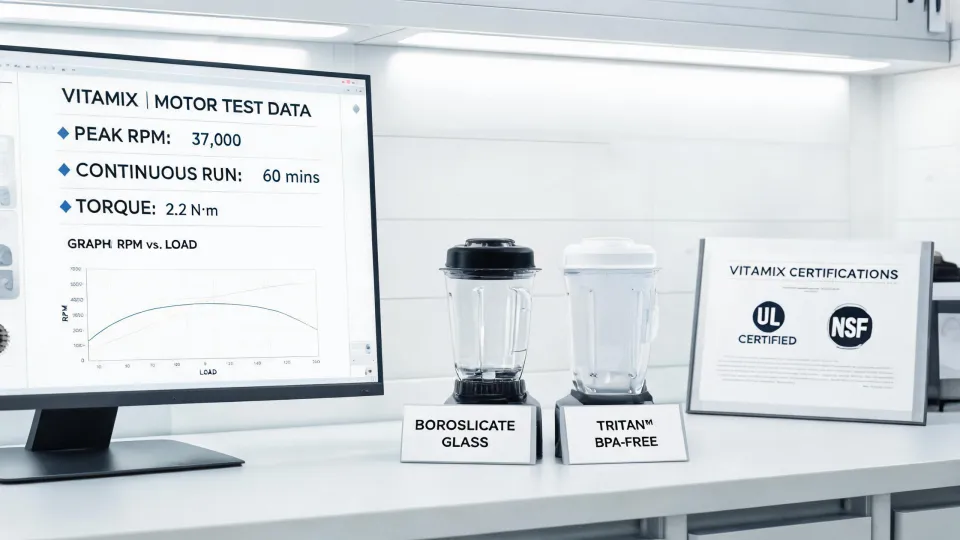
Physically, some fit. But the fit is not the same. Home-grade containers have thinner walls and lighter bearings. On our bench tests (we run 50+ blends a day for two weeks straight), cheaper containers developed stress cracks and cloudy resin within days. Genuine containers use copolyester that handles impact and repeated thermal cycling. There's also the warranty question: using a non-Vitamix container can void the base warranty. On a $700 machine, that's a risk I wouldn't take.
I get the appeal of saving $80 on a container—budgets are real. To be fair, some aftermarket parts are decent for home use. But commercial duty cycles are a different animal. When a crack forms during lunch rush, the savings vanish. If you're replacing a container on a commercial unit, stick with genuine parts or check with Vitamix directly about approved third-party options.
4. What's the real total cost of a commercial Vitamix?
Total cost of ownership (i.e., not just the purchase price) includes replacement parts, downtime, and repair risk. Let's rough it over five years for a single unit:
- Commercial base: $600–800
- Two container replacements: $360–440
- Three lid replacements: $45–90
- Routine care (cleaning, drive socket checks): $0–50
That's roughly $1,000–1,300 (dealer quotes, January 2025). Now compare: a $250 consumer blender every 12–18 months runs $750–1,250 over five years. The numbers converge—but the commercial machine blends faster and keeps consistency, which matters when every smoothie needs the same texture. Time is also a cost. I do not mean a few seconds here and there—I mean the throughput difference across hundreds of blends a day. And downtime is the hidden line item: when a commercial unit fails, service stops. That's the expense that never appears on a receipt.
5. What actually makes a blender "commercial grade"?
I'm the quality and brand compliance manager at a commercial kitchen equipment distributor. I review every blender before it ships—roughly 200 units a month, and I've rejected about 8% of incoming deliveries in 2024 due to specs that were visibly off. When I look at a machine, I check four things: the motor duty rating (commercial units run continuously without thermal shutdown), the drive spline (metal, not plastic), the container material (copolyester or polycarbonate, not basic PET), and the warranty language.
When I implemented our verification protocol in 2022, we started measuring motor labels against actual draw. You'd be surprised how many units claim specs they don't meet. That's not a rare exception—it's consistently a few units in every batch. With blenders, the brand name gets you in the door, but the spec sheet is what keeps the machine running in a commercial kitchen. "Within industry standard" is a phrase I've learned to distrust.
6. Do I need a mini deep freezer for blender prep?
If frozen fruit is part of your smoothie program, yes. A mini deep freezer under the counter (5–7 cubic feet) keeps frozen fruit, banana chunks, and pre-portioned bases accessible without opening the main walk-in. That's a $300–600 appliance (major retailer listings, January 2025), and it pays for itself by cutting steps during service. One habit I recommend: rotate stock first-in, first-out, and keep the freezer at 0°F or below (FDA guideline). I've seen operators store fruit above that, and the texture degrades—which defeats the purpose of a high-end blender. Also, give the freezer room to breathe. A unit crammed in a corner overheats, and then you're calling a repair tech during the busiest week of the year.
7. Can I make congee in a rice cooker for my menu?
Yes. A commercial rice cooker with a porridge setting handles congee (rice porridge) well—gentle heat over an extended time, which is exactly what the dish needs. The ratio is roughly 1:8 to 1:10 rice to water (think 8 parts liquid for a loose congee). Use a 10-cup or larger unit for lunch service batches. A decent 10-cup rice cooker runs $80–200 (retail listings, January 2025).
It's a separate tool from your blender, but both serve the same goal: menu consistency. The rice cooker nails the base; your Vitamix handles the sauces, dressings, and purees alongside it. I'd also note that making congee ties up the cooker for a couple of hours, so schedule it early or buy a second insert—backup capacity matters when you add a dish to the menu.
8. What is an HE washer, and why should a kitchen care?
An HE (high-efficiency) washer uses less water and requires low-sudsing detergent. If someone uses regular detergent in an HE machine, excess suds extend cycles and can trigger error codes—slow turnaround on kitchen linens and towels. For a café that goes through bar cloths daily, that's a real bottleneck. The fix is simple: use HE detergent and measure it correctly.
My experience here is based on about 200 commercial kitchen equipment orders, mostly blenders and small wares; if your operation runs serious laundry volume, a commercial laundry setup is a different calculation entirely. But the HE question comes up often enough to flag: check the detergent spec before the first load, not after the machine's flashing an error code during prep. Your blender is the star, but the washer keeps the towels coming back.

Greta Lindholm
Greta Lindholm is a household refrigeration analyst covering French-door, side-by-side, top- and bottom-mount refrigerators, mini fridges, beverage coolers, chest freezers, and upright freezers. She applies IEC 62552 and IEC 60335-2-24 while comparing energy consumption, usable volume, pull-down time, compartment temperature stability, freezing capacity, noise, door-seal leakage, refrigerant charge, and ambient-temperature performance. Her guides help importers, distributors, private-label teams, and appliance engineers select platforms around climate class, storage mix, efficiency labels, cabinet dimensions, service access, shipping density, and warranty exposure.