The Vitamix Quiet One Blender Changed My Mind About Commercial Kitchen Noise
2026-08-31 · Greta Lindholm
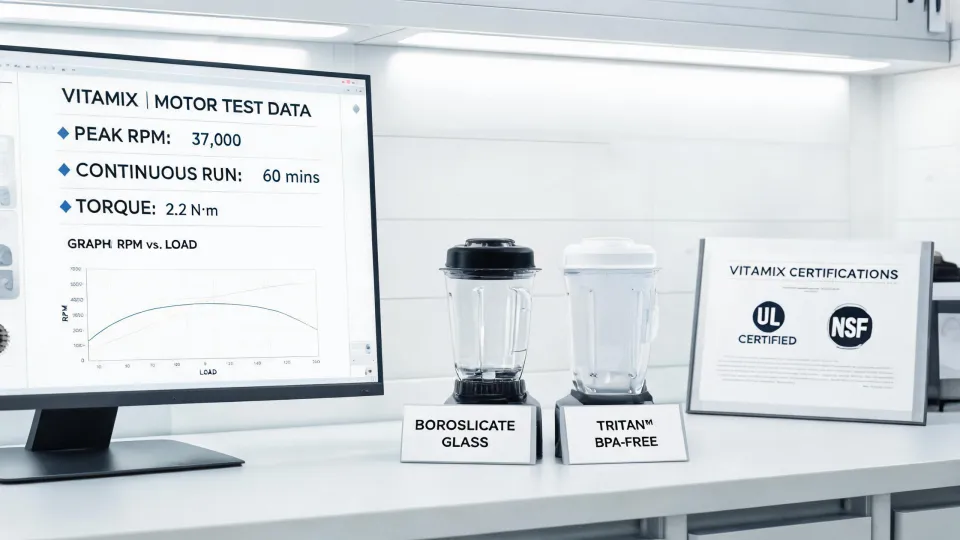
I'm going to say something that gets me dirty looks at industry trade shows: the Vitamix Quiet One blender isn't a luxury accessory for high-volume commercial kitchens. It's a throughput tool. I review commercial blenders for a living, and for years I treated "quiet" as a nice-to-have. Then I audited a juice bar where the blender was the single biggest bottleneck, and I had to rethink everything.
To be clear about who's talking: I'm a quality/compliance manager at a commercial kitchen equipment company. I review roughly 300 units per year before they reach customers. In 2024, I rejected 9% of first shipments—mostly because of container tolerance and calibration issues, not motor power. I don't care what the marketing sheet says; I care what happens when the machine runs for an hour with frozen berries in it.
Noise Is Not a Comfort Metric. It's a Communication Metric.
Most blender specs talk about horsepower and container capacity. Those matter. But the overlooked spec is the sound profile under load. When a legacy commercial blender hits a frozen strawberry mix, the noise level at the operator's position can easily climb past 85 dBA. That's the NIOSH recommended exposure limit for an eight-hour shift—as of January 2025, at least. In a busy café, that means blenders are running close to a barista's ear, order tickets are getting shouted over, and mistakes creep in.
When we tested the Vitamix Quiet One blender in a real service environment, the first comment from the staff wasn't "it's quiet." It was "we can hear the customer now." That's the metric that doesn't show up on a spec sheet.
Here's the Counterintuitive Part: Quiet Blenders Make Better Consistency
I used to think noise was purely a staff-comfort issue. Everything I'd read about commercial blenders said to focus on durability and blend power. In practice, the biggest quality issue I saw was caused by the noise itself. When a blender is loud, the operator's instinct is to turn it off as soon as it sounds done—not when the recipe actually finished. The result? A cold, chunky smoothie that feels gritty, and no one knows why the texture varies between shifts.
The quiet motor changes that behavior. If the machine doesn't make an operator feel like they're standing next to a jackhammer, they'll let the programmed cycle finish. In one juice bar we audited, switching to the Vitamix Quiet One blender didn't just reduce sound complaints—it cut the variation in finished drink texture. The staff was finishing the cycle, not rushing the machine.
What I Actually Check When I Inspect a Quiet Blender
My job is to catch problems before customers do. So when a new model like the Vitamix Quiet One blender comes in, I don't just read the published sound level. I check three things:
- Sound at the operator's ear, not from the catalog—we run the unit with a full container of ice and water, then measure at where someone would actually stand. A quiet enclosure doesn't help if vibration travels through the counter.
- Cycle completion behavior—does the machine hold the programmed speed until the last second? If it softens before the timer ends, you'll get inconsistent results.
- Build tolerance consistency—we measure container seating and lid alignment on multiple units. A quiet blender is only useful if it seals the same way every time.
We didn't always have a formal decibel test in our acceptance protocol. That's on me. The third time a "bad" blender came back, the unit was fine—the problem was the demo setup. The motor's low-frequency vibration was resonating through a flimsy metal counter, and the manager thought the machine was broken. Once I started testing on the same surface type as the customer would use, we caught issues before they shipped.
What About the Price?
I know the objection: the Quiet One costs more than a standard commercial blender. And if you don't have a noise problem, buy the standard unit. But in a high-volume operation, the cost per use matters more than the sticker price. If a quieter machine lets one staff member take an order while a drink blends, and if it prevents one texture complaint per shift, the efficiency payback is faster than most equipment upgrades.
Bottom line: the Vitamix Quiet One blender is the rare piece of equipment that fixes a quality problem and a human problem at the same time. It's not about being quiet for quiet's sake. It's about giving your team the margins to hear, think, and finish the job.

Greta Lindholm
Greta Lindholm is a household refrigeration analyst covering French-door, side-by-side, top- and bottom-mount refrigerators, mini fridges, beverage coolers, chest freezers, and upright freezers. She applies IEC 62552 and IEC 60335-2-24 while comparing energy consumption, usable volume, pull-down time, compartment temperature stability, freezing capacity, noise, door-seal leakage, refrigerant charge, and ambient-temperature performance. Her guides help importers, distributors, private-label teams, and appliance engineers select platforms around climate class, storage mix, efficiency labels, cabinet dimensions, service access, shipping density, and warranty exposure.