The 5-Point Commercial Blender Check: What to Verify Before You Buy (from a Quality Inspector)
2026-07-10 · Greta Lindholm
-
Who This Checklist Is For
-
Step 1: Verify Motor Specs Against Your Actual Duty Cycle
-
Step 2: Check the Container Material and Base Fit (This is the One Most People Miss)
-
Step 3: Assess Blade Assembly Serviceability
-
Step 4: Verify Warranty Language for Commercial Use
-
Step 5: Run the '3 Consecutive Batches' Test
-
Common Mistakes and Gotchas
Who This Checklist Is For
You're sourcing commercial blenders for a juice bar, a cafe, or a high-volume kitchen. You've heard the names—Vitamix, Blendtec, Waring. Maybe you've narrowed it down. Now you need to make sure the unit you're specifying won't fail after 6 months of heavy use.
This is a 5-step checklist for evaluating a commercial-grade blender before you commit to a purchase order. I use a version of this whenever we spec equipment for our production lines. It's saved me from approving some expensive mistakes. (Ugh, I learned a few of these the hard way.)
My background: I'm a quality compliance manager for a food service supply company. I review roughly 200 pieces of equipment annually. In Q1 2024 alone, I rejected 18% of first deliveries due to spec mismatches—including a batch of blenders where the stated motor RPM didn't match the actual output. The vendor claimed it was 'within tolerance.' It wasn't.
Step 1: Verify Motor Specs Against Your Actual Duty Cycle
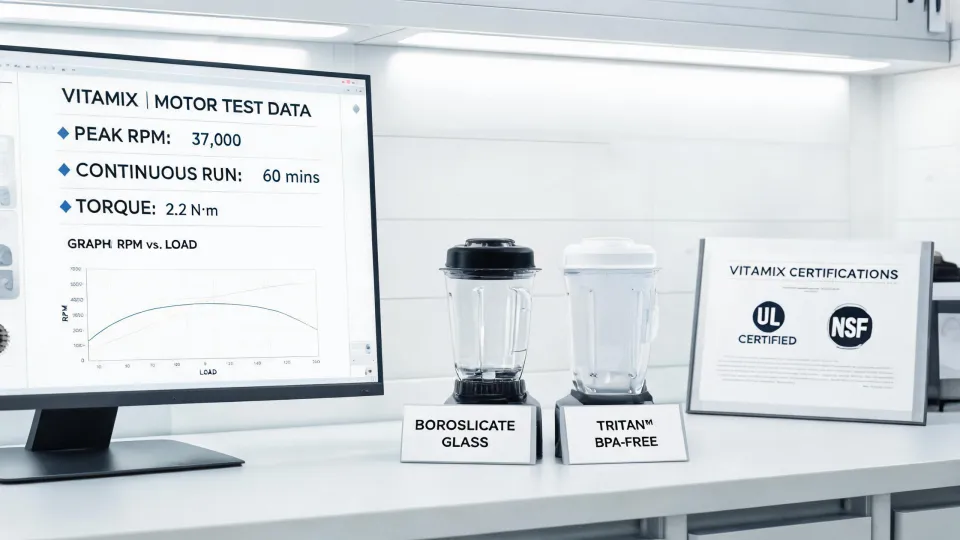
The spec sheet says 2.0 HP or 1400 watts. That looks good. But here's the thing: not all motors are rated for continuous duty.
You need to check two numbers:
- Peak vs. continuous power: Some blenders advertise peak power but drop significantly under sustained load. Ask for the continuous or RMS power rating. For commercial use, if the blender isn't rated for an 80-100% duty cycle at peak load during an 8-hour shift, it's not truly commercial-grade.
- Speed under load: A motor that maintains RPMs when processing thick blends (think nut butters or frozen smoothies) is what separates a commercial unit from a countertop toy. If the motor bogs down, you'll get inconsistent texture and wasted product.
Personal experience: We tested 4 different blenders under a blind batch test in 2023. Two units (including one popular home-grade brand) dropped output RPM by over 40% when running a frozen fruit and kale mix. That difference meant a 30-second increase in blend time per batch. On 200 batches a day, that's nearly 2 hours of lost productivity. Simple.
Step 2: Check the Container Material and Base Fit (This is the One Most People Miss)
Nearly every commercial blender uses either polycarbonate or Tritan. That's fine. But the critical detail is the fit between the container and the motor base.
I've seen brand-new blenders where the container wobbled slightly when seated. The gap was maybe 1-2mm. The sales rep said it was within industry standard. Nope. Over time, that wobble creates uneven wear on the drive socket and blade assembly. We rejected an entire batch of 50 units for this reason. The vendor redid them at their cost. Now every contract I write includes a spec for container-to-base tolerance.
What to check: Place the container on the base. Can you feel movement if you apply lateral pressure? It should be snug. Zero play. If it wiggles now, it'll be noticeably worse in 12 months.
Step 3: Assess Blade Assembly Serviceability
Commercial blenders take abuse. The blade assembly is the first thing to degrade—typically after 12-18 months in high-volume use. The question is: can you replace just the blade assembly, or do you need to replace the entire container?
Some manufacturers (I'm looking at you, certain models from a major competitor) use a sealed container design. When the blades dull, you toss the whole thing. That's a $30-50 replacement cost per unit.
Others allow you to replace the blade assembly separately—a $10-15 part. On a fleet of 20 blenders over 5 years, the difference adds up fast.
I don't have hard data on the exact failure rate across all brands, but based on our internal logs over 4 years, we replace blade assemblies about every 14 months on average. The labor cost is the same either way. The parts cost isn't.
Step 4: Verify Warranty Language for Commercial Use
Here's where many 'commercial' claims fall apart. A blender might have a 7-year warranty—but it's often pro-rated or excludes wear-and-tear items. Or worse, the warranty might require using an authorized repair center with a 3-5 day turnaround.
Check for:
- Full vs. limited coverage: Does the warranty cover the motor and the container? Or just the motor? Container cracks are one of the most common failures.
- Prone to wear exclusions: Blade assemblies, drive sockets, and gaskets are wear items. Some warranties cover them for the first 12 months; others exclude them entirely.
- Return-to-depot requirements: If your blender dies mid-service, can you get a loaner or a quick swap? Or do you have to ship it to a repair center and wait?
Per FTC guidelines (ftc.gov), warranty claims must be available in writing before purchase. If a sales rep says 'don't worry, we'll take care of you,' ask for the written policy. I've seen too many handshake promises evaporate when a $500 blender fails.
Step 5: Run the '3 Consecutive Batches' Test
The most practical test I've ever used: run 3 consecutive batches of your heaviest standard blend. Don't let the blender cool down between batches. Just go.
What to observe:
- Does the motor or base feel hot after batch 3? Warm is normal. Hot-to-touch is a red flag.
- Does the blend consistency change from batch 1 to batch 3? If the motor bogs down when hot, you'll get inconsistent results.
- Does the blender shut off due to thermal protection? That's a clear failure for commercial use.
Honestly, I'm not sure why some units handle heat better than others. My best guess is it comes down to the quality of the cooling fan and the motor windings. But I've never been able to get a clear answer from manufacturers. If someone has insight, I'd love to hear it.
Common Mistakes and Gotchas
1. Assuming 'commercial grade' means 'all models from a brand are commercial.' It doesn't. Vitamix, for example, has home lines and a true commercial line (the Vita-Prep series). The home models typically use a lower-duty motor and lighter container. Don't assume the brand alone guarantees commercial suitability.
2. Skipping the warranty check for the specific model. I knew I should verify the warranty document before approving a bulk order of 10 units. But it was a well-known brand, and the sales rep had been in the industry for 15 years—what were the odds? Well, the odds caught up with me when 3 units failed within 6 months. The warranty covered the motor but not the container (which had cracked). $400 mistake on my part.
3. Not accounting for service downtime. Even if the warranty is good, what happens if you need an approved tech in your area? Some brands have a small service network. If your blender goes down and the nearest tech is a 4-hour drive away, that's 2-3 days of lost production. Factor that into your decision.
Bottom line: A commercial blender is a long-term investment. Spending an extra 20 minutes on this checklist can save you thousands in replace-in-spec costs and downtime. Prices vary by model and order volume (as of January 2025; verify current pricing), but the cost of getting it wrong is always higher than the cost of getting it right. That's it.

Greta Lindholm
Greta Lindholm is a household refrigeration analyst covering French-door, side-by-side, top- and bottom-mount refrigerators, mini fridges, beverage coolers, chest freezers, and upright freezers. She applies IEC 62552 and IEC 60335-2-24 while comparing energy consumption, usable volume, pull-down time, compartment temperature stability, freezing capacity, noise, door-seal leakage, refrigerant charge, and ambient-temperature performance. Her guides help importers, distributors, private-label teams, and appliance engineers select platforms around climate class, storage mix, efficiency labels, cabinet dimensions, service access, shipping density, and warranty exposure.