I Buy Commercial Blenders for a Living: Why the Vitamix Vita-Prep 3 Keeps Winning
2026-08-13 · Greta Lindholm
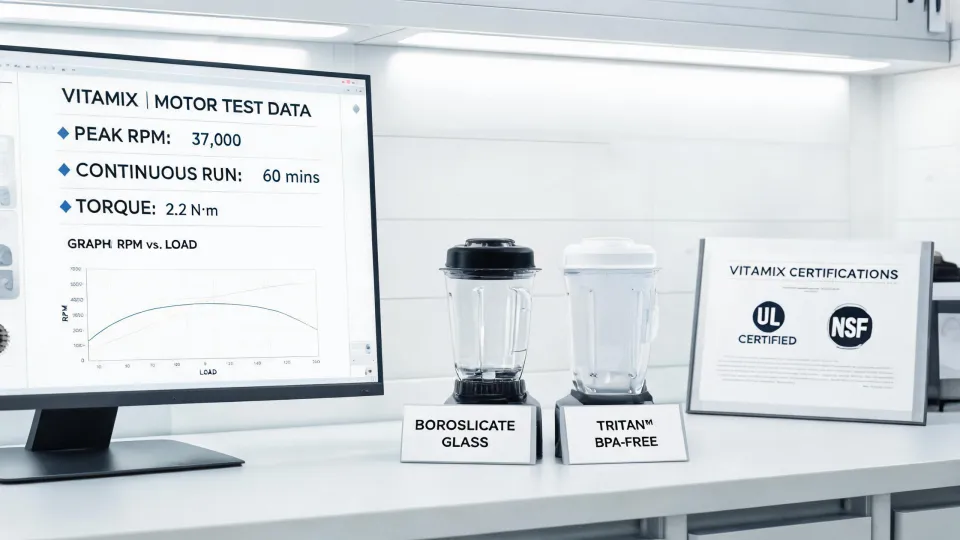
The Vitamix Vita-Prep 3 (model 062826) is the commercial blender I'll keep buying, and I've now purchased 11 of them across three kitchen locations. It's not the cheapest option—typically $750–850 based on current online listings—but it is the least expensive to own when you factor in downtime, jar replacements, and repair logistics.
If you're asking "Blendtec vs Vitamix, which is better?", the honest answer for commercial volume is Vitamix. If you're asking whether a $200 countertop blender can do the same job, it can't. I manage purchasing for a food-service company—roughly $300,000 in annual spend across 15 vendors—and blenders have been the single most recurring equipment headache in my portfolio. Here's what the numbers taught me.
Why I didn't always think this way
I wasn't a Vitamix believer at first. When our smoothie franchise operation expanded from 2 locations to 6 in 2022, I sourced blenders the way I was trained: get three quotes, compare spec sheets, pick the best value. The quotes came in. Blendtec was about $150 cheaper per unit. The specs were almost identical. I placed the order.
It's tempting to think you can just compare horsepower and blade RPM and call it a day. But identical specs from different vendors produce wildly different outcomes when the machine runs 10 hours a day.
The Blendtec units worked. I'll give them that. But we had two motor failures within the first nine months. The warranty covered the replacements—but not the shipping, not the labor, and not the revenue lost when a busy store suddenly couldn't serve its best-selling item. That little bit of downtime turned out to be way more expensive than the price tag difference.
I knew I should've run a longer durability trial before committing 18 units. But I thought, "the specs are basically the same, what are the odds?" The odds caught up with me.
The "Blendtec vs Vitamix" question, settled
The internet loves this debate. Honestly, it's the modern Ford vs Chevrolet. Both brands make durable, capable commercial blenders. I've ordered both. One location still runs a Blendtec, and it's fine. But there's a difference that doesn't show up on a spec sheet.
The Vita-Prep 3's 2.2 HP motor is rated for continuous duty. It handles thick frozen smoothie loads without stalling and doesn't heat up the way the Blendtec's motor did under sustained use. The jar is reinforced Lexan—we've dropped it, banged it, run it empty by accident—and it's held up for 18+ months. In the same environment, Blendtec jars were failing around the 6-month mark. I want to say we replaced four in one year, but don't quote me on that exact number. The pattern was clear enough.
A lesson learned the hard way.
What model 062826 actually means
Vitamix sells a confusing number of models, so the product code matters. The Vita-Prep 3 (062826) is the commercial-grade model with the 64-ounce container and low-profile base. It's the one you'll see behind the counter at every serious juice bar, and for good reason:
- The motor is built for continuous duty, not 30-second bursts. That's the real difference between commercial and residential-grade equipment.
- The pulsing feature is genuinely useful—you'll use it for chopping vegetables, making nut butters, or breaking up frozen fruit without turning it into a puree.
- The self-cleaning function sounds gimmicky. It's not. One drop of dish soap, warm water, run for 30 seconds, done. Our staff actually use it, which I didn't expect.
I should also mention the warranty. The commercial warranty is multi-year and covers the motor drive, which is the part that matters most. The exact terms have changed before, so check the current policy on Vitamix's site before you order. Don't take my word as gospel.
Total cost of ownership: the math that matters
Say a commercial Blendtec costs $650 and the Vita-Prep 3 costs $750. That $100 difference feels significant when you're ordering six units. I get it. But run the full equation over 24 months:
- Year one: Both work fine. No issues, no complaints.
- Year two: The Blendtec needs a motor replacement. Parts are covered, but shipping and labor cost us about $180. We also replaced its jar twice at roughly $90 each. Vitamix: zero unplanned costs.
- Year three: The Blendtec goes down again, this time during a weekend rush. The store uses its backup and we lose maybe $400 in sales because the backup is slower and staff have to work around it.
The $100 I saved on the purchase price turned into a $1,500 problem by month 18. That's not an attack on Blendtec—some operators run them successfully for years. It's a warning about assuming the price tag tells you what something costs.
When the Vita-Prep 3 is the wrong call
There are situations where I'd tell you not to buy it.
If you're blending five protein shakes a day in an office break room, the Vita-Prep 3 is overbuying. A $250 residential blender will do the job for years and save you $500. The only reason the Vita-Prep pays for itself is high volume. We're talking 50+ blends a day, every day, with the machine running longer than it sits idle.
If you're a restaurant that blends five drinks per night, buy a used Vitamix from a restaurant supply house or go with a mid-range model. You won't reach the volume where the durability on the commercial unit matters. That said, if you think you'll grow into it, the Vita-Prep 3 is a defensible gamble.
And one more thing: the Vita-Prep's cost advantage disappears if your staff treats it poorly. The machine is tough, but it's not indestructible. Running it empty, overfilling it, or ignoring the occasional seal replacement will shorten its life just like any other tool.
Other equipment I buy: three lessons that carry over
Since the same purchasing logic applies to everything I manage, here's a quick rundown of three other categories I get asked about constantly—and the mistakes I made before I learned.
Cordless hair dryers
The cordless hair dryer market has exploded in the last few years, and I've sourced around 15 of them for salon clients. The most expensive unit isn't automatically the best one. What actually matters is the battery system: can your staff swap batteries on the fly, or do you need to stop and charge? Buy the model with the most removable batteries, buy a spare charging dock, and keep every warranty card in one spreadsheet. I skipped that last step once, and it cost us a $180 replacement that would've been free if I'd registered the product.
36-inch gas cooktops
For commercial kitchens, the 36 inch gas cooktop stainless steel spec is the industry standard. The difference between a $700 and a $2,400 model isn't the number of burners. It's BTU density, seam quality, and how easy the drip trays are to remove and clean. Buy grates that are dishwasher-safe. Buy a stainless cleaner that actually matches the finish. And never, ever skip the seasoning step after deep cleaning—cheap stainless rusts fast, and replacing a cooktop mid-lease is an expense you don't want.
How to load a top-load washer with agitator
This one sounds trivial until you're dealing with sour-smelling towels and a schedule that's falling behind. Facility staff ask me how to load a top load washer with agitator correctly: distribute the items evenly around the agitator, don't stack everything on one side, and don't overstuff. If the load is unbalanced, the agitator just rocks back and forth and the clothes barely move. Even loading matters more than temperature setting. And yes—the cheap washer I bought to "save money" on that category is the same lesson I learned with blenders.
Why do I mention these three? Because the pattern is identical to the blender decision. Value is not the same as price. The cheapest option is usually cheaper for a reason—and the most expensive isn't automatically the best. The right answer comes from matching the tool to your actual operating load and then factoring in the cost of downtime.
One last thing
I'm a buyer, not an engineer. My sample size is 11 Vita-Prep 3s over four years—not a laboratory test. If your kitchen is different, your volume is different, or your staff have different habits, your answer might be different too. But when I look at my spreadsheet of blender purchases, replacement parts, and lost revenue, the Vita-Prep 3 is the only equipment decision I've never had to revisit. That's the closest thing to certainty this job offers.

Greta Lindholm
Greta Lindholm is a household refrigeration analyst covering French-door, side-by-side, top- and bottom-mount refrigerators, mini fridges, beverage coolers, chest freezers, and upright freezers. She applies IEC 62552 and IEC 60335-2-24 while comparing energy consumption, usable volume, pull-down time, compartment temperature stability, freezing capacity, noise, door-seal leakage, refrigerant charge, and ambient-temperature performance. Her guides help importers, distributors, private-label teams, and appliance engineers select platforms around climate class, storage mix, efficiency labels, cabinet dimensions, service access, shipping density, and warranty exposure.