6 Things I Check Before Buying a Commercial Blender (A Procurement Manager's Checklist)
2026-07-16 · Greta Lindholm
-
Who This Checklist Is For
-
Step 1: Calculate the 3-Year Total Cost of Ownership (Not Just the Sticker Price)
-
Step 2: Match the Motor Specs to Your Actual Volume (Don't Over-Buy or Under-Buy)
-
Step 3: Verify the Build Quality for Your Specific Environment
-
Step 4: Test the Vendor’s Responsiveness (Before You Need Them)
-
Step 5: Match the Product Line to Your Real Needs (Don't Buy Features You Won't Use)
-
Step 6: Read the Warranty Like a Lawyer (Then Read It Again)
-
Common Mistakes I’ve Seen (and Made)
-
Bottom Line
Who This Checklist Is For
If you're running a juice bar, a hotel kitchen, or a high-volume café, the blender you pick is going to be touched by your staff ten times a day, every day. A bad choice costs you in repairs, wasted product, and tickets backing up.
This isn't a review blog. I'm a procurement manager. Over the past 6 years, I've helped audit over $180,000 in cumulative spending on kitchen equipment for a 50-person food service operation. I've negotiated with more than a dozen vendors and documented every invoice in our cost tracking system. I learned the hard way that the "best" blender on paper isn't always the most profitable one for your business.
Here are the 6 steps I run through every time I evaluate a commercial blender purchase.
Step 1: Calculate the 3-Year Total Cost of Ownership (Not Just the Sticker Price)
This is the most common mistake I see. A buyer sees a blender for $400 and another for $700. The $400 one wins on price. But that's rarely the full story.
Here's what I include in my calculation:
- Blade replacement cost. Some blenders need new blades every 6 months under heavy use. At $30 a pop, that's $60 a year.
- Container replacement cost. A cracked 64-ounce Lexan container can cost anywhere from $40 to $120, depending on the brand and model.
- Motor warranty coverage. A 3-year warranty vs. a 7-year warranty has a dollar value. If the motor dies in year 4, that's a full replacement cost.
- Electricity consumption (minor, but worth a note). A high-efficiency motor will save you a few hundred dollars over 3 years in a busy shop.
I've seen a $400 blender end up costing $1,020 over 3 years after blade and container replacements. Meanwhile, a $700 Vitamix with a 7-year warranty and a self-cleaning cycle had a 3-year TCO of $730. That's a 28% difference hidden in the fine print.
"I assumed 'same specifications' meant identical results across vendors. Didn't verify. Turned out each had slightly different interpretations of 'commercial duty.'"
Step 2: Match the Motor Specs to Your Actual Volume (Don't Over-Buy or Under-Buy)
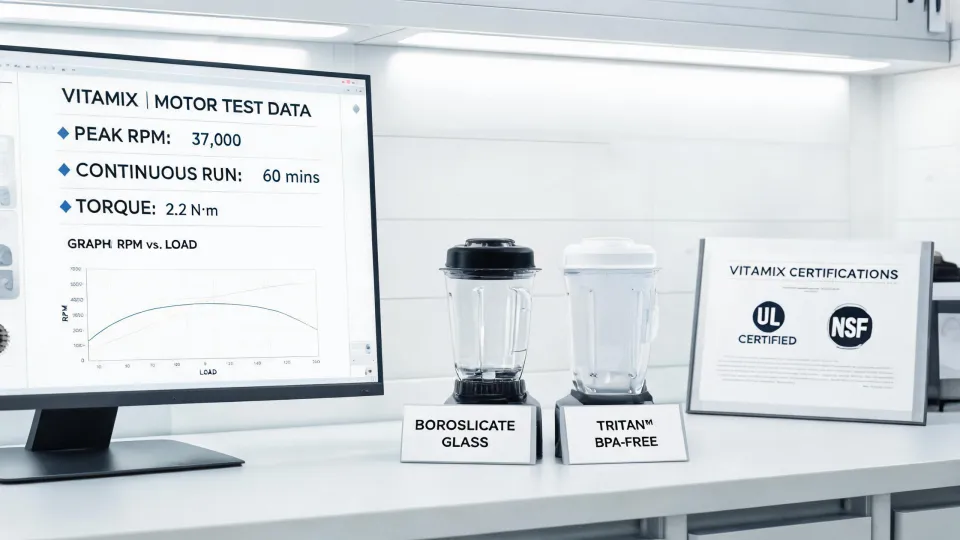
A 2 HP motor is standard for most commercial blenders. It'll blend smoothies, soups, and frozen drinks all day. But if you're making nut butters or grinding large batches of spices, you need more torque — a 3.5 HP motor, which is common in high-end models like the Vitamix Vita-Prep 3.
Conversely, if you're only making 10 drinks a day, a 2 HP blender is overkill. You're paying for a motor you'll never use. I've seen small cafés buy the top-of-the-line model and end up with a machine that's literally too powerful for their needs — it pulverizes ice into snow and ruins the texture of their signature slushie.
Check this: Ask the vendor for a “test blend” agreement. Blend 3 batches of your hardest product (frozen fruit, ice, heavy syrup). If the motor labors or the blades jam, it’s the wrong machine.
Step 3: Verify the Build Quality for Your Specific Environment
I've seen a $1,200 blender fail because it wasn't designed for the steam and moisture of a commercial kitchen. The control panel shorted out in 8 months.
What to look for:
- Sealed control panels. A rubber gasket around the switches and buttons prevents moisture ingress.
- Metal drive socket. Plastic drive sockets wear out faster and can crack under heavy use. Metal is standard on higher-end models like the Vitamix Pro 750.
- Thermal protection. A blender that shuts down when the motor overheats is a blender that will disrupt your service. Some models have automatic reset, some don't. Know which one you're buying.
I learned never to assume the proof represents the final product after receiving a batch of blenders that looked nothing like the sales demo unit. The demo had a thick, rubberized base. The shipment had a thin, injection-molded one. (Note to self: always get a "production sample" before placing a large order.)
Step 4: Test the Vendor’s Responsiveness (Before You Need Them)
If a blender goes down at 10 AM on a Saturday, and your brunch rush is on, a slow vendor response can cost you thousands in lost sales. I've started grading vendors on a simple metric: time to first response on a weekend service ticket.
Here's my checklist:
- Call their warranty support number on a Saturday morning. See if anyone picks up.
- Ask for a list of authorized service centers in your area. Get their phone numbers and call them.
- Ask the vendor for a "loaner policy." If your blender needs service, will they provide a replacement while it's in the shop? Some will, some won't.
I once switched vendors because the new one had a 24-hour replacement policy. The old one took an average of 11 days to process a warranty claim. That 'free setup' offer actually cost us $450 more in hidden fees when we factored in service delays.
Step 5: Match the Product Line to Your Real Needs (Don't Buy Features You Won't Use)
A brand like Vitamix has a broad product line. They make blenders for home use, for commercial use, and for high-volume industrial use. The Vitamix Propel Series 750 Blender, for instance, is a premium machine with programmable settings and a self-cleaning cycle. Those are great features if you have a barista who needs to run 50 smoothies an hour. But if you're a small bakery making 10 smoothies a day, you're paying for an expensive timer.
The vendor who said 'this isn't our strength—here's who does it better' earned my trust for everything else. I'd rather work with a specialist who knows their limits than a generalist who overpromises. When I was looking at a machine that also claimed to chop vegetables, I asked the vendor to demonstrate it on a bushel of onions. It failed. They were honest and pointed me to a dedicated food processor.
Step 6: Read the Warranty Like a Lawyer (Then Read It Again)
Warranties are where the real costs hide. Here's what I check:
- What's covered vs. what's not. Blades and containers are often considered "consumables" and excluded from full warranty coverage.
- Labor costs. Some warranties cover parts but not labor. A $50 part can cost $150 to install if you have to ship the unit.
- Average turnaround time. I ask the vendor for the average time from service request to completed repair. (I really should document this in our vendor scorecard.)
Common Mistakes I’ve Seen (and Made)
1. Ignoring the total cost of ownership: The $400 blender seemed like a steal. After three years of replacing blades and containers, I’d spent more than the $700 model would have cost.
2. Not testing with your actual product: A smoothie made with frozen strawberries is a lot more demanding than one made with thawed ones. Test with your specific ingredients, not the vendor’s stock demo mix.
3. Assuming all blenders are created equal for high-volume use: A 2 HP motor can hum along for 5 years in a low-volume environment. In a high-volume juice bar, it might burn out in 18 months. Look for models with thermal protection and a heavy-duty motor.
4. Trusting the “commercial” label: Some manufacturers label a blender as “commercial” when it's really just a pro-sumer model. Check the warranty length and the motor’s duty cycle rating. A true commercial blender should have a warranty of at least 3 years and be designed to run continuously for extended periods.
5. Forgetting about noise: If your kitchen is open to the dining area, a noisy blender can be a real problem. I've seen a café buy a model that sounded like a jet engine. They ended up moving the blending station to the back of the house. That added 15 seconds to every smoothie order. It adds up.
6. Not considering the ergonomics: A heavy blender that is hard to lift and clean is a safety risk. Look for models with a tilting base or a lightweight container. Your staff will thank you.
Bottom Line
Choosing a commercial blender is a real operational decision. It's not about picking a brand off a list. It's about matching the machine to your volume, your product, and your budget. If you've been burned by a bad purchase before, you'll know exactly what I'm talking about. A checklist like this is meant to make the process repeatable, not perfect. Every kitchen is different. The details matter more than the name on the side of the blender.

Greta Lindholm
Greta Lindholm is a household refrigeration analyst covering French-door, side-by-side, top- and bottom-mount refrigerators, mini fridges, beverage coolers, chest freezers, and upright freezers. She applies IEC 62552 and IEC 60335-2-24 while comparing energy consumption, usable volume, pull-down time, compartment temperature stability, freezing capacity, noise, door-seal leakage, refrigerant charge, and ambient-temperature performance. Her guides help importers, distributors, private-label teams, and appliance engineers select platforms around climate class, storage mix, efficiency labels, cabinet dimensions, service access, shipping density, and warranty exposure.