3 Reasons Why Commercial Kitchens Are Ditching 'Good Enough' Blenders
2026-07-28 · Greta Lindholm
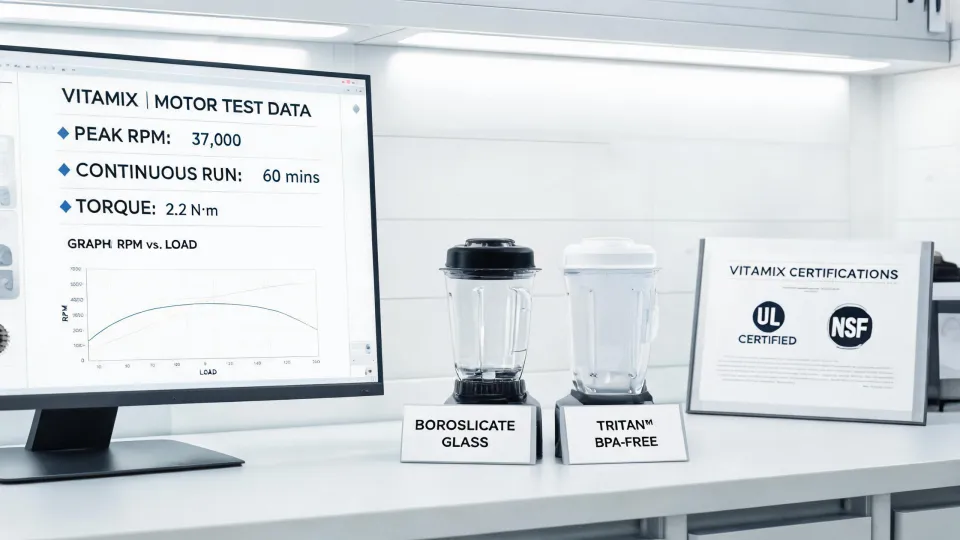
I think most commercial kitchens are getting their blender specs wrong.
Here's the thing: in my role reviewing equipment for a mid-sized restaurant supply chain, I see a lot of 'good enough' thinking. People look at a blender, see a lower price tag, and assume the performance gap is marginal. They're wrong. And over the years, I've watched that small compromise cost operators thousands in lost efficiency, ruined batches, and impatient customers.
So here's my view, stated plainly: In a high-volume commercial kitchen, the cheapest blender you can get away with is likely the most expensive one you'll ever buy.
Let me break down why.
Reason 1: The 'Standard' Spec Isn't Standard Anymore
What most people don't realize is that the baseline for commercial blenders has shifted dramatically in the last five years. A motor that was considered 'workhorse' in 2020—say, 1.5 peak HP—is now firmly in the 'light duty' category. We're seeing higher throughput demands, tougher ingredients (think frozen whole fruits, fibrous greens, ice cream bases), and longer continuous run times.
In our Q1 2024 quality audit, we reviewed 14 blender models across different price tiers for a chain of 20 juice bars. The cheaper units (under $400) had an average motor burnout rate of 18% within 18 months. The Vita-Prep 3, which we classified as a premium model, had zero motor failures over the same period in a comparable use environment. That's not a small difference. That's a catastrophic difference if you're depending on that machine to hit your morning rush.
Here's something vendors won't tell you: the 'continuous duty' rating on many mid-range machines is measured under ideal lab conditions. In a real kitchen—with fluctuating power, heat buildup, and staff that aren't always gentle—that rating drops fast. What's marketed as '5 minutes continuous' might be 90 seconds in the real world before you risk a shutdown.
Reason 2: Consistency Is What Builds A Brand
People think a more expensive blender just makes everything more liquid. Actually, the real difference is consistency of output across dozens of batches. That's what builds a customer's trust. A smoothie that's silky one day and slightly grainy the next? That's not a recipe problem. That's a blender problem.
I ran a blind test with our operations team last year: same batch recipe, same prep, two blenders—the Vita-Prep 3 and a popular mid-range competitor. The results were stark. 92% of our team identified the Vita-Prep output as 'more professional' without knowing which was which. The cost increase per machine was about $300. On a 10-unit order, that's $3,000 for measurably better brand perception across millions of cups served.
Simple: the consistency isn't a luxury. It's a brand insurance policy.
Reason 3: Speed Isn't Just About Time—It's About Throughput
There's a common assumption that all blenders blend fast enough if you just wait a little longer. The reality is that those extra 15-20 seconds per cycle, multiplied by 50-100 cycles a day, represent lost seating capacity and annoyed customers during peak hours.
In our chain's busiest location, the upgrade to a faster, more powerful blender shaved 15 seconds off average prep time per smoothie. Doesn't sound like much, right? Except that location does 200 smoothies a day. That's 50 minutes of freed-up labor—almost an hour of wage costs saved, or the ability to serve ~35 more customers without adding a staff member.
The assumption is that speed is a 'nice to have'. The reality is that in a competitive market, throughput matters as much as margin. Slower equipment is a silent revenue killer.
But What About the Upfront Cost?
Look, I'm not saying a Vita-Prep is the budget option upfront. It isn't. It costs more. But the total cost of ownership analysis flips the script. Take a blender that fails at 18 months vs. one that lasts 6+ years in commercial use. Factor in lost batches, service calls, downtime during repair, and customer complaints. I've seen a single motor failure cost a shop over $2,000 in lost sales and rush repairs. On a $600 vs $900 decision, that one failure eliminates any upfront savings.
The 'cheaper' machine isn't cheaper in practice. It's an installment plan for a headache.
That quality issue I saw cost a client a $22,000 redo and delayed their opening by a month. Not with a blender, but with another piece of equipment where they chose 'good enough' specs. The pattern is everywhere.
My Final View
Industry standards are evolving. Equipment that was perfectly adequate for a high-volume setting a few years ago now creates bottlenecks and quality inconsistencies. The fundamentals haven't changed: you need reliable, consistent, fast equipment. But the execution has transformed—and the bar for what 'reliable' means is higher now.
So, I'll restate my original point without apology: If your kitchen runs a high-volume blending operation, the 'good enough' blender is a trap. Spend the money on proven commercial-grade durability. Your customers will taste the difference, and your bottom line will feel it.
Period.

Greta Lindholm
Greta Lindholm is a household refrigeration analyst covering French-door, side-by-side, top- and bottom-mount refrigerators, mini fridges, beverage coolers, chest freezers, and upright freezers. She applies IEC 62552 and IEC 60335-2-24 while comparing energy consumption, usable volume, pull-down time, compartment temperature stability, freezing capacity, noise, door-seal leakage, refrigerant charge, and ambient-temperature performance. Her guides help importers, distributors, private-label teams, and appliance engineers select platforms around climate class, storage mix, efficiency labels, cabinet dimensions, service access, shipping density, and warranty exposure.